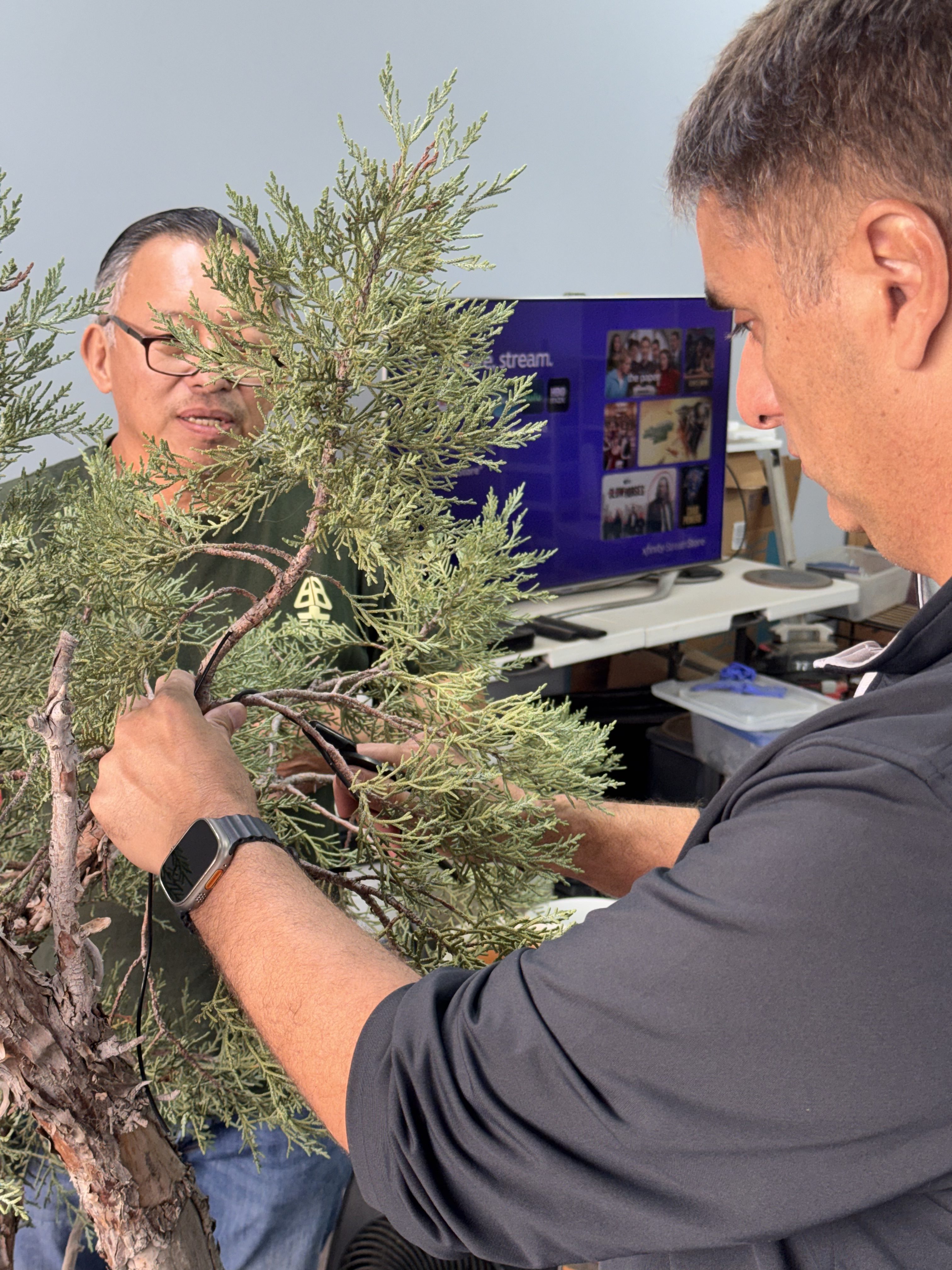
North Highlands, California — September 2026
Some trips are carefully planned. Others work out through luck, and this was one of the lucky ones.
Who is Boon?
In the American bonsai world, the name “Boon” needs no introduction. Boonyarat Manakitivipart, known to everyone simply as Boon, is originally from Thailand and worked as an ornamental tree pruner before moving to the Bay Area. His growth as an artist came from a deep commitment to doing things the right way. He hosted Akio Kondo, a young Japanese bonsai professional, in his own home for a year, and that time became an extensive education for him. He later studied with Kihachiro Kamiya, a decorated Japanese master known for his expertise in black pine and needle juniper, and he founded Bay Island Bonsai.
What sets Boon apart is his students as much as his own trees. He is widely credited with influencing a generation of Western bonsai artists through his intensive programs, and many names I’ve come to know and admire trace their roots back to his garden.

The thread that led me here
Two of those students are already part of this blog’s story. Jonas Dupuich, whose Bonsai Tonight has been a steady companion on my own learning curve, first met Boon in 1993 at his family’s nursery in Alameda, when a stranger started giving him pruning advice. Peter Tea, whose garden I just wrote about, also came up through Boon’s teaching before heading to Japan.
Why wiring is the foundation of everything
If you ask most beginners what bonsai is about, they’ll mention pruning, pots, or the look of an old tree. But the longer I practice, the clearer it becomes: wiring is the grammar of bonsai. Wire is the way to imitate what nature does to the tree, Without it, you can’t write a sentence.
Wiring is how we place branches in space, create movement, open the canopy to light, and build the foliage pads that make a tree read as mature and aged. Every design decision eventually becomes a wiring decision. And bad wiring is worse than no wiring at all. It scars bark, snaps branches, and locks in mistakes for years.
The fundamentals sound simple on paper:
- Choose the right gauge. The wire should hold the branch in its new position without overwhelming it.
- Always anchor. A wire that isn’t anchored will just spin. You either wire two branches with one piece of wire or anchor the wire around the trunk or a stronger branch.
- Keep a consistent angle. Coils at about 45 degrees give holding power without strangling the branch. If they’re too tight, they don’t hold. If they’re too loose, they bite in.
- Wire in the direction of the bend. The wire must support the outside of each bend, or it will unwind as you shape.
- Work from thick to thin. Trunk first, then primary branches, secondary branches, and finally the tips.
- Keep it clean. Wires should run parallel, never cross, and avoid trapping foliage or buds.
- Know when to remove it. Wire comes off before it bites into the bark, and it’s always cut off, never unwound.
Reading a list is one thing. Getting your hands to do it consistently, on a real tree, with a teacher watching every coil, is something else entirely.

Starting with the collection
We didn’t start with wire. We started with a walk.
Boon took us through his private collection on the first morning, and it set the tone for everything that followed.


Every tree showed decades of patient, precise work. Branches were placed exactly where they should be, foliage pads were layered and full of light, and the wiring was so clean you could barely see it.
The focus of the weekend was junipers, since this is the right season to wire and style them. Walking among Boon’s junipers, something shifted for me. I’ve always had junipers in my collection, but I had never really seen them before. I fell in love with junipers.
Why the bonsai world is obsessed with junipers
It’s easy to understand once you’ve spent time with great ones. Junipers are extremely forgiving to wire, since their live branches can take dramatic bends that would snap most other species. They build dense, lush foliage pads when they’re properly developed. Most importantly, they offer something few other species can: the striking contrast between live veins and bleached deadwood, jin and shari, which tell the story of a tree that has survived harsh conditions for centuries.


From California and Sierra junipers collected in the mountains to Japanese shimpaku, junipers have become a classic canvas for bonsai art. They reward skill and patience, and they’re unforgiving of shortcuts, which makes them the perfect teacher.

The workshop: repetition and perfection
Then came the work, and there was a lot of it.
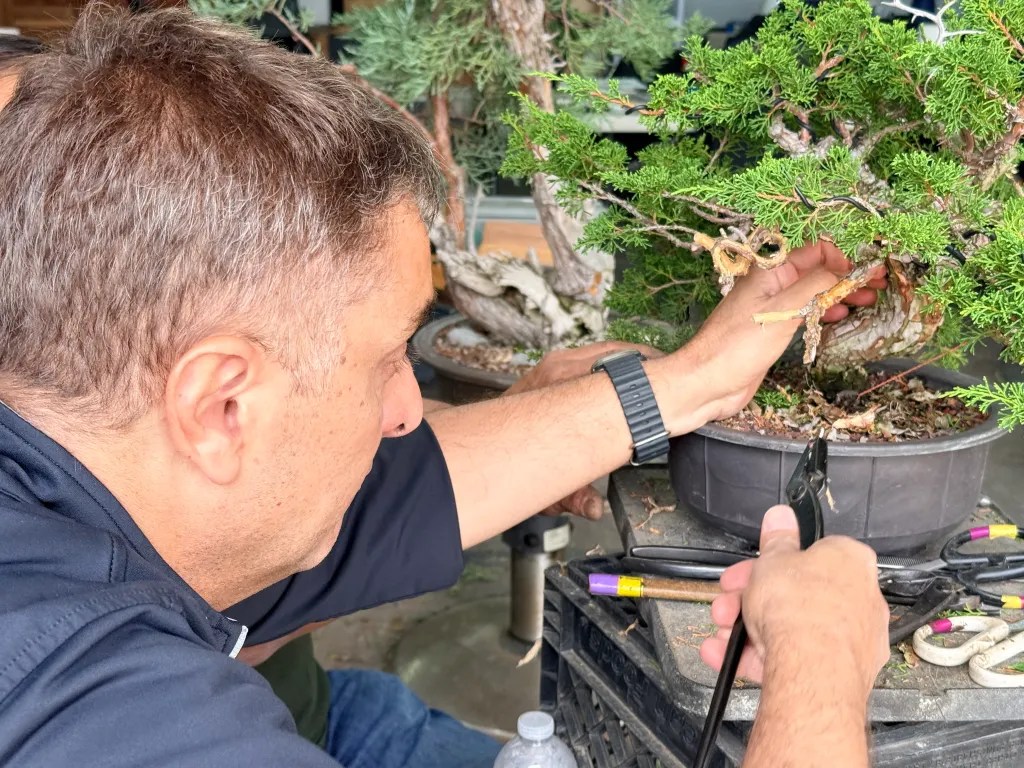
Boon’s approach is thorough and methodical. We wired, he inspected, and more often than not, we unwired and did it again. A coil at the wrong angle, a wire that crossed another, an anchor that wasn’t quite solid: nothing escaped him. It wasn’t about being harsh. He simply wouldn’t accept “almost right,” because he knows that’s where bad habits take root.
By the end of the second day, my hands had changed. I wouldn’t call it second nature just yet – but I felt I’m starting to get it!


Two students and a new friend
Another piece of luck: there were only two students in the workshop. That meant nearly one-on-one time with Boon for two full days, a rare privilege with a teacher of his stature.
The second piece of luck was that the other student was Megan. Within the first hour, we discovered she lives in the Santa Clara area, just a few minutes from my office there. It felt like the bonsai world was once again shrinking in the best possible way. Megan is deeply connected to the Bay Area bonsai scene, volunteering at Lake Merrit collection I just visited few months ago and knows very well the big names in the Bay Area in… We bonded right away, comparing trees, trading stories, and laughing at our own wiring mistakes.
Some people you meet at a workshop, and some people you know you’ll keep on the journey with you. Megan is definitely the second kind. With my regular trips to Santa Clara, I already know we’ll be seeing each other at gardens, shows, and hopefully more workshops.


Closing
I came for a wiring workshop. I left with steadier hands, a new appreciation for junipers, a deeper understanding of the lineage that connects Boon, Jonas, and Peter, and a new friend on the other side of the world.
That’s what this journey keeps teaching me: the trees bring you in, and the people keep you there.


Leave a Reply