Bonsai Nomad

Tag: japan

  • Epilogue: The Gyouzan — My Travel Companion

    Epilogue: The Gyouzan — My Travel Companion

    Every great Japan trip ends with customs forms and existential questions about what you’ve done to your bank account. Mine ended with both of those things, plus a negotiation I never expected to have at Haneda Airport: convincing an Emirates ground agent that a nearly one-meter, 20-kilogram Gyouzan pot was, in fact, carry-on luggage.

    Let me explain.

    The pot had been with me since the very first day.
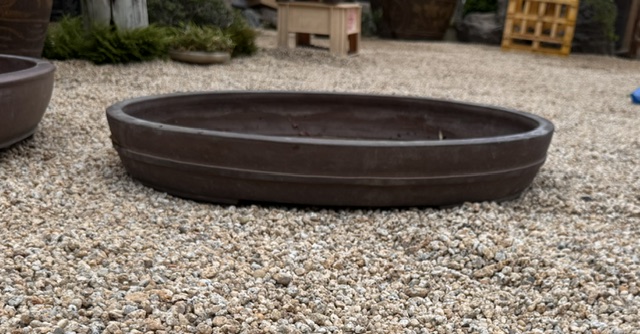
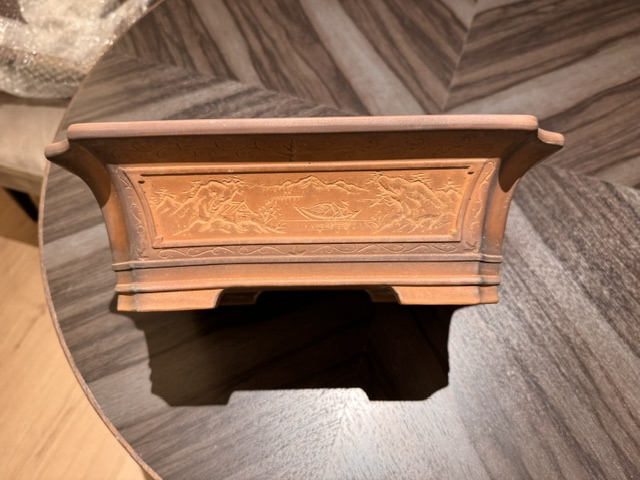
    As I wrote in my Shunkaen post, it found me at Kobayashi-san’s garden before the pilgrimage had even properly begun — a massive, unglazed oval Gyouzan, almost a meter long and closer to 20 kilograms than I was comfortable admitting. The kind of piece that stops you mid-sentence. I bought it, made arrangements to collect it before my flight, and then spent the rest of the trip with the quiet knowledge that this thing was coming home with me, one way or another.

    It had accompanied me — in spirit if not always in hand — through Omiya, through Kimura’s workshop, through the kilns of Tokoname, through the temples of Kyoto and the workshops of Shizuoka. By the time I arrived at Haneda for the Emirates flight to Dubai, the pot and I had a relationship. I was not putting it in the hold.

    The Emirates agent at check-in looked at the pot. Then at me. Then, slowly, back at the pot.

    “What is that?”

    “It’s a work of art,” I said. Which is true. “It’s handmade. By a master. In Japan.” All of this is also true. “And it’s very fragile.” Absolutely true.

    What I did not volunteer was that it weighed as much as a small child and was nearly as long as the check-in desk we were standing at.

    After a consultation with a colleague, a supervisor, and what appeared to be a third opinion sourced purely for emotional support, they waved me through. The pot had cleared its first border.
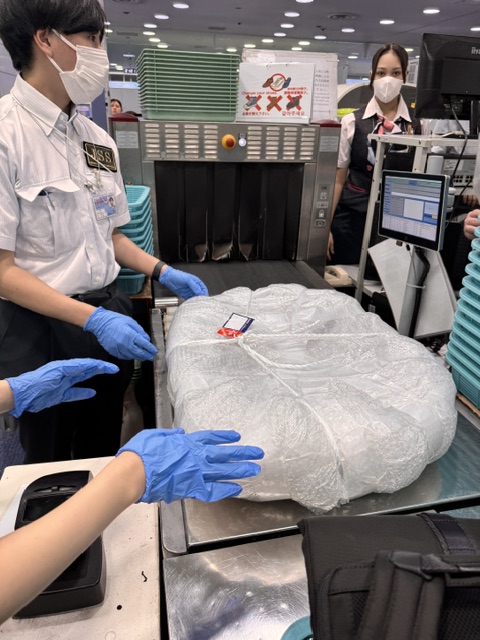
    I want to be precise here: it did not fit easily. What followed was a logistical operation involving careful rotation, two patient flight attendants, and a level of commitment from everyone in row 14 that I will never forget. But it went in. The overhead bin closed. I sat down and exhaled for the first time in about twenty minutes.

    The cabin gets cold at altitude. Everyone knows this.

    The flight attendant who noticed the blanketed overhead bin chose not to comment. I have enormous respect for her. An unglazed Gyouzan is a porous material. It feels the cold.

    We landed in Dubai. The pot and I descended together — me carrying it off the plane with the grim focus of a man who has committed fully to a decision — and boarded the bus to the terminal.

    There is something clarifying about standing on an airport bus at 5:30 am with 20 kilograms of Japanese ceramic in your arms, surrounded by strangers, thinking: I would do this again immediately.

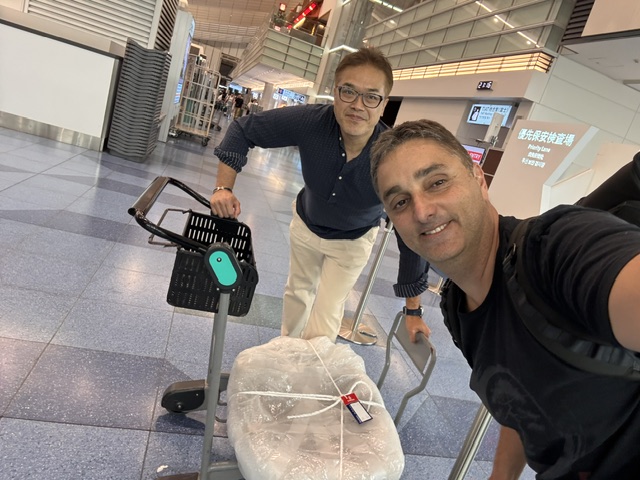
    The layover was long… The pot rightfully demanded its own sofa chair.

    I got a light breakfast. The pot got admired by a passing traveler who asked if it was a serving dish. I said it was a bonsai pot. He looked at its dimensions and said, “what size tree?” I said, “that’s the question, isn’t it.” We understood each other.


    Tel Aviv. Ben Gurion. The final stretch. I’d carried this thing from Kobayashi-san’s garden in Tokyo all the way across two continents, and now I was walking through arrivals with it.
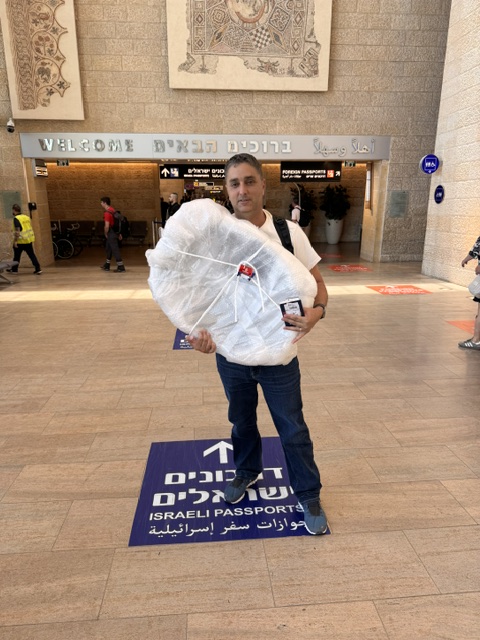
    Home. Almost.

    Erez, the Taxi driver looked at what I was attempting to load into his car.

    “What is it this time?”

    “A pot.”

    “Bonsai Again?”

    “Yep, Bonsai….”

    He Smiled…..

    He helped me get it in. A man of good judgment and, it turned out, a surprisingly spacious back seat.

    And there it is. Door to door, Tokyo to Tel Aviv, Kobayashi-san’s garden to my own. The Gyouzan traveled the length of Japan with me, cleared Emirates check-in on charm and audacity alone, spent a night in the Dubai lounge, and arrived home without a scratch.
    Now it waits — as all great pots do — for the right tree. Something that earns it. Something worthy of what it took to get here.

    The pilgrimage is over. The real work is just beginning.
  • Saturday with Jeff: When Plan B Beats Plan A

    Saturday with Jeff: When Plan B Beats Plan A

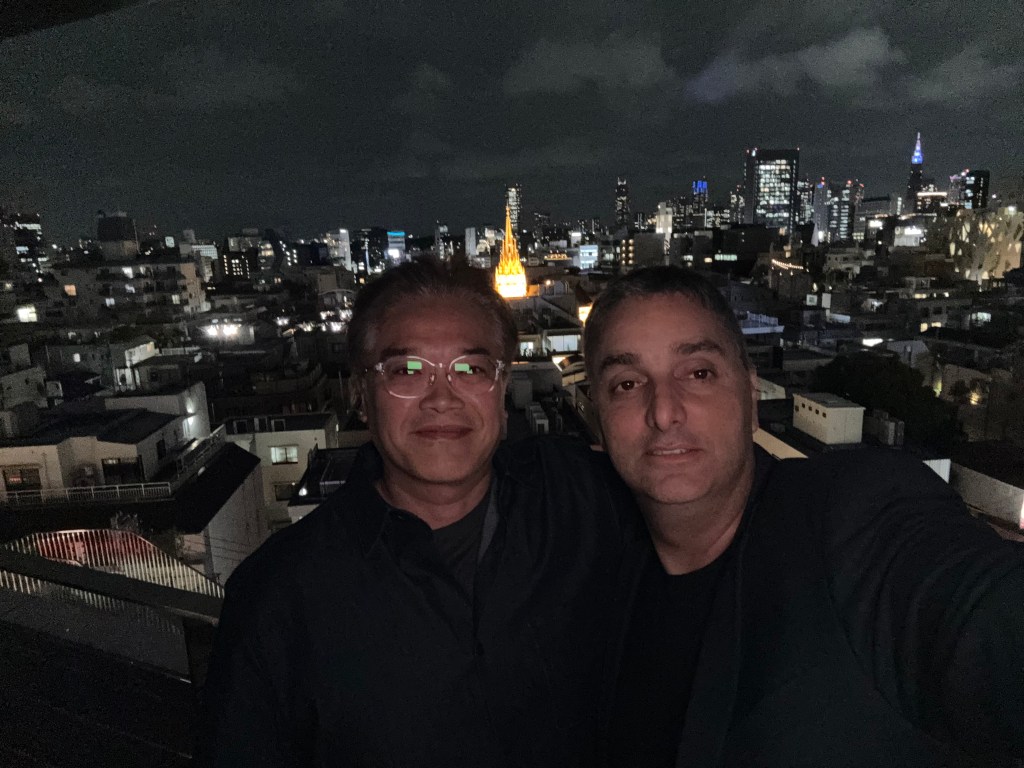
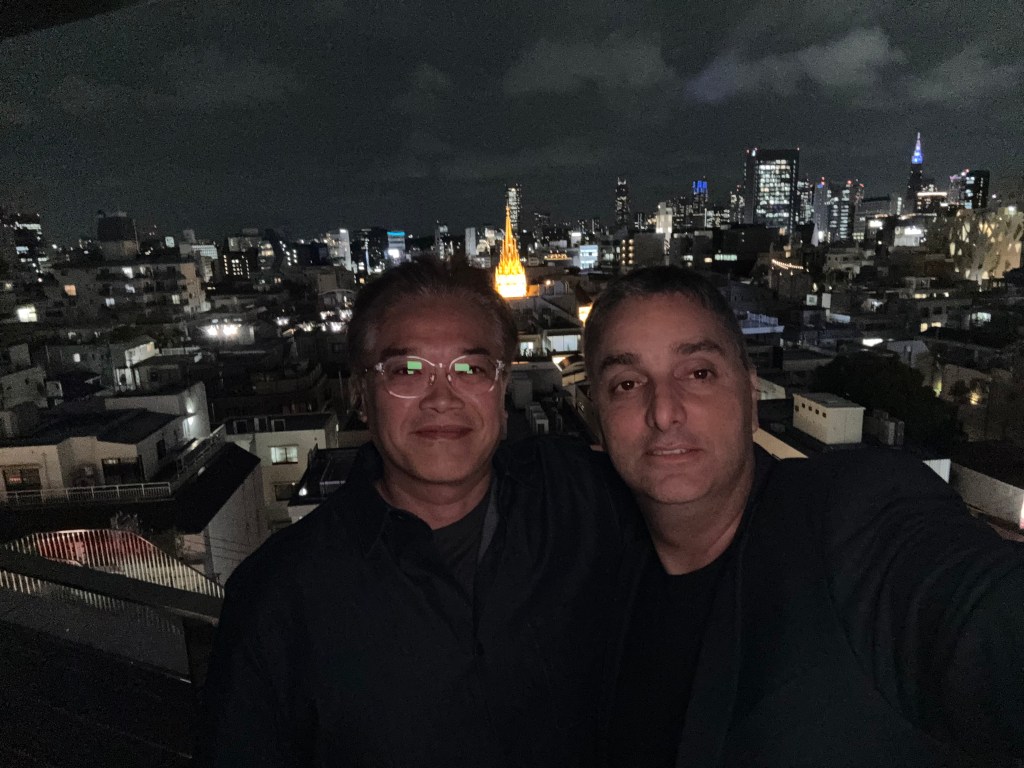
    My first weekend in Japan was reserved for an old friend. Jeff and I worked together at RSA years ago, and he’d hosted me on my very first trip to Japan back in 2015. The moment I told him I was coming, he insisted on clearing his weekend — and had the perfect idea: a drive out to Mt. Fuji.

    We left Tokyo and hit heavy traffic almost immediately — which, in hindsight, was a gift. It gave us hours to properly catch up after so many years apart. Slowly the city melted away into mountains and trees, and the scenery turned beautiful.

    But as we got closer to Fuji, the clouds rolled in thick. No mountain views today. Time for Plan B — and you can probably guess what that meant for me.

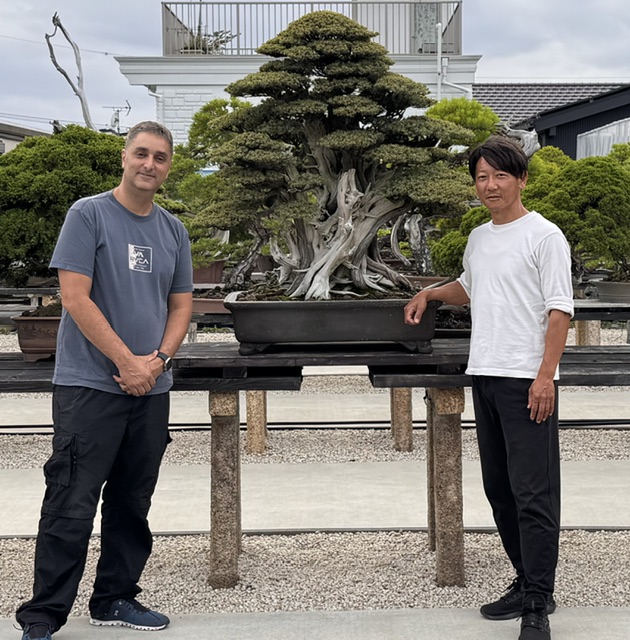
    A quick search turned up Taishoen, a nursery in the area. Jeff, ever the connector, called ahead to make sure it was okay for us to drop by.

    Taishoen Nursery — A Quick Highlight
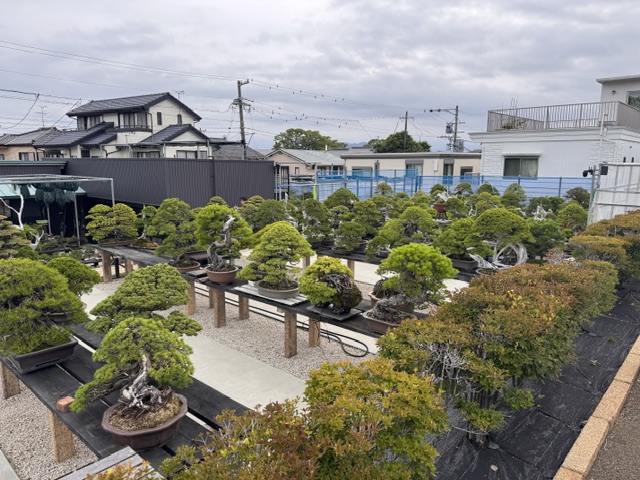
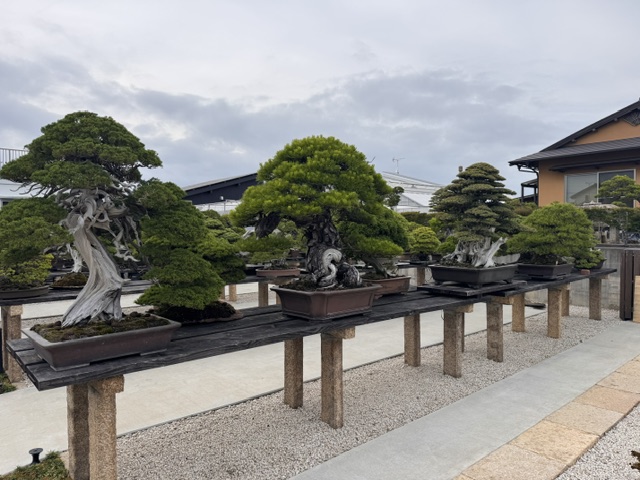
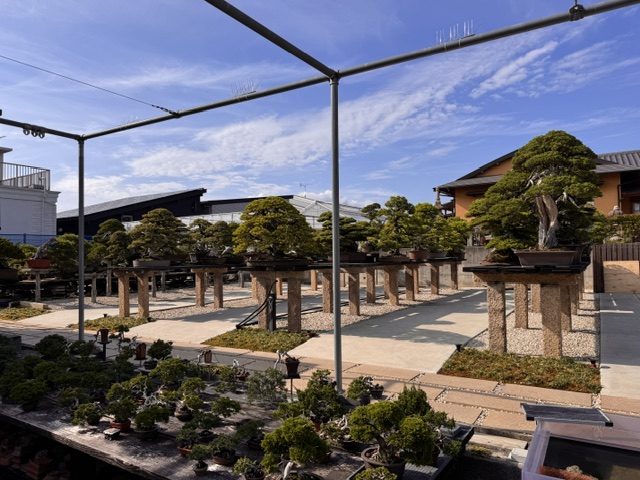
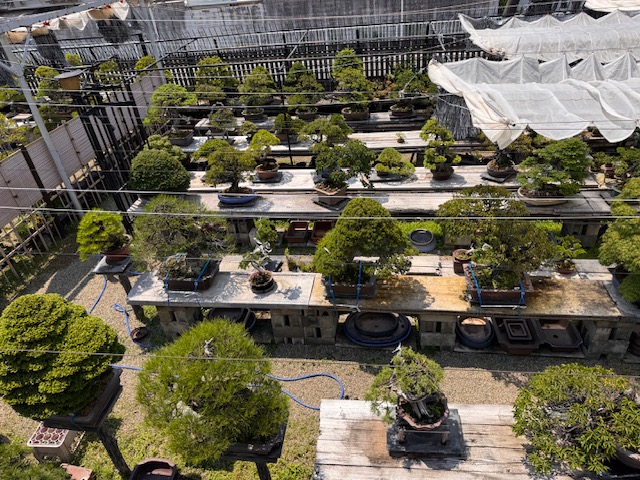
    Taishoen is renowned for its shohin-sized bonsai and sits right at the foot of Mt. Fuji in Shizuoka. These days it’s run by Taiga Urushibata — son of the legendary Nobuichi Urushibata — who apprenticed under Kimura himself. Taiga speaks fluent English and welcomes foreign students for multi-month study programs, which come highly recommended.

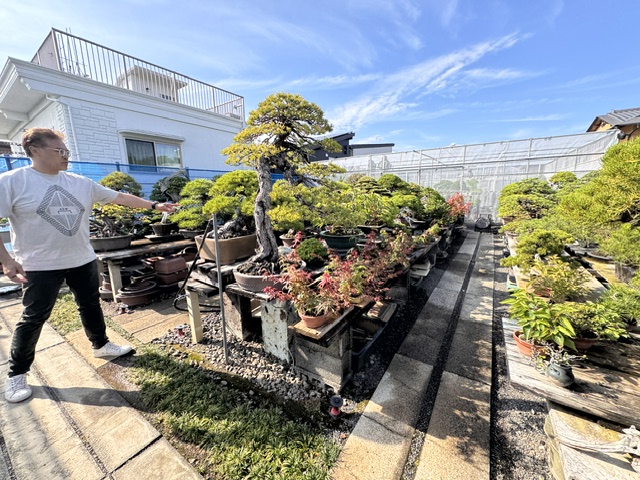
    What we found was nothing like I expected — a surprisingly large, state-of-the-art nursery I’d had no idea existed, tucked away in a part of Japan I hadn’t even planned to visit. Some of the best moments are the ones you don’t plan.

    Taiga welcomed us warmly and gave us a full tour — stunning trees, and pots that stopped me in my tracks. One in particular: a Bigei. I called Shai on the spot for a second opinion. His answer left no room for debate: “Take it. Price doesn’t matter — it’s a Bigei. Take it.” So I did.

    Jeff and I spent a couple of hours wandering the nursery — for him, it was his first time stepping into this world, and his curiosity about my new obsession was obvious. Don’t be surprised if BonsaiNomad gets a guest contributor someday.

    We drove back to Tokyo as the light faded — tomorrow, back to work with the team in Japan. But the weekend had already given me more than I bargained for: an old friendship renewed, a hidden gem of a nursery, and a Bigei pot I’ll treasure for years.

  • Japan Bonsai Pilgrimage, Part 3: Bjorn!!!

    Japan Bonsai Pilgrimage, Part 3: Bjorn!!!

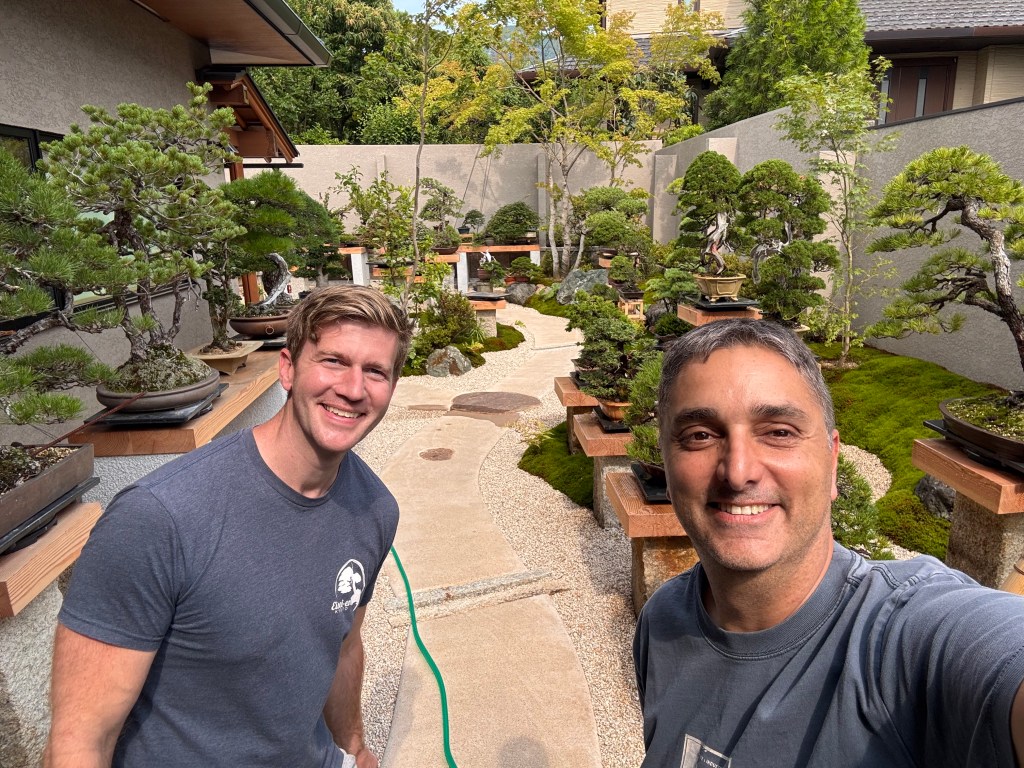
    If you’ve spent any time in the bonsai world, you know the name Bjorn Bjorholm. As the founder of Bonsai-U and Eisei-en, he’s brought hundreds of video lessons to enthusiasts everywhere — I’d guess there’s barely a serious bonsai person today who hasn’t learned something from him online. I certainly have.

    Bjorn’s own story is part of what makes him so compelling: a Nashville native who apprenticed in Osaka, built his own center back home, and then — after years of sharing his journey online — made the leap to move permanently to Kyoto with his wife and daughter. Many of us followed along as he designed his new garden from the ground up, and getting to see it in person had been a quiet dream of mine for a long time.

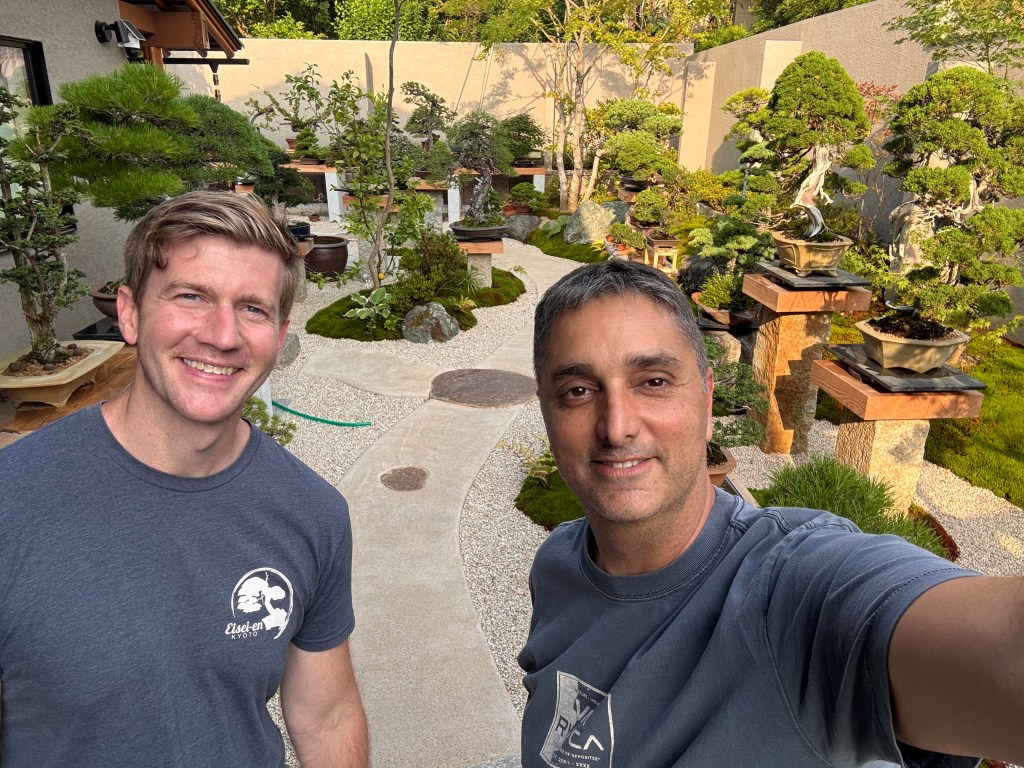
    Through Shai, my teacher and mentor, I reached out — and Bjorn said yes right away, offering me two full days at his place.

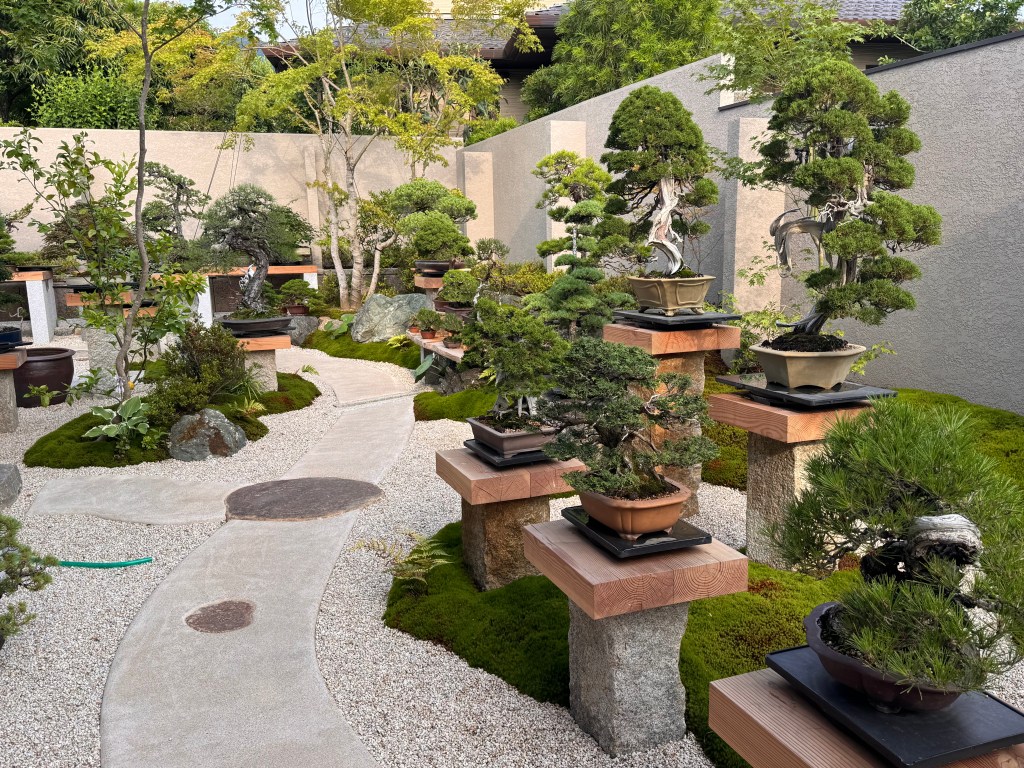
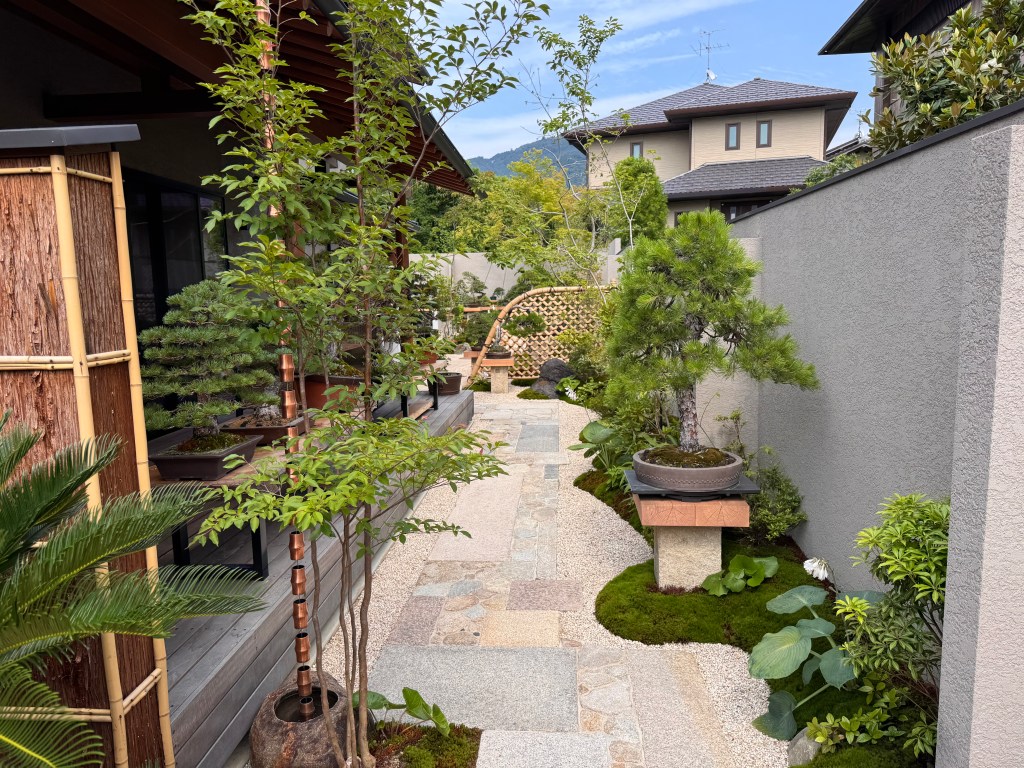
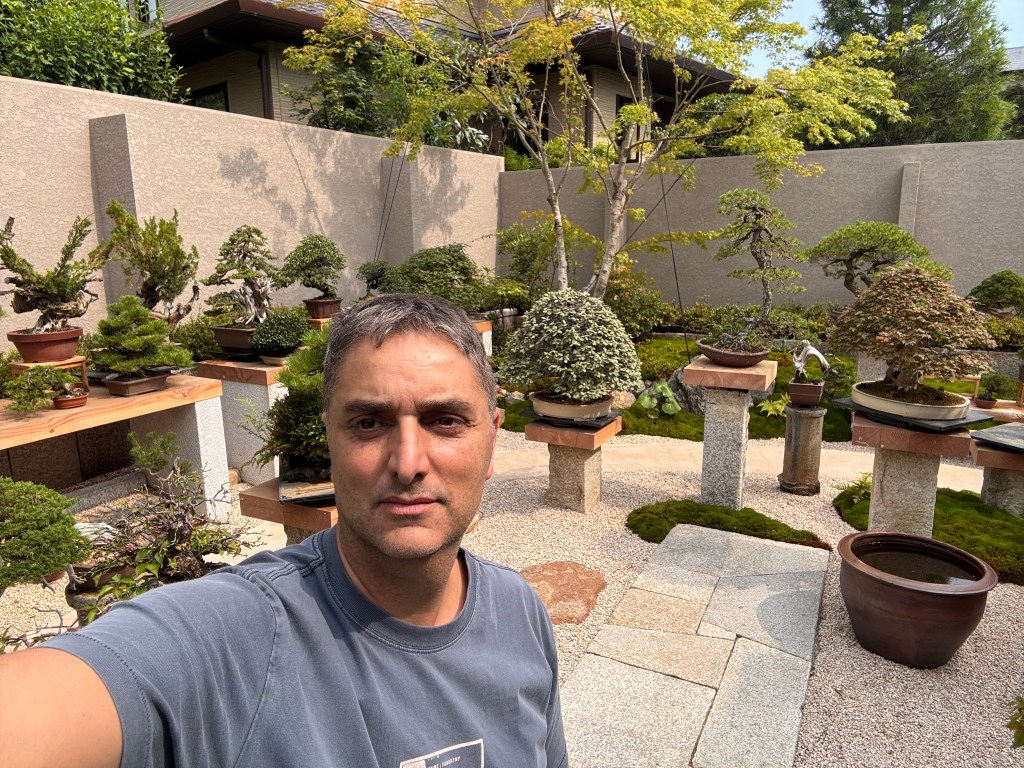
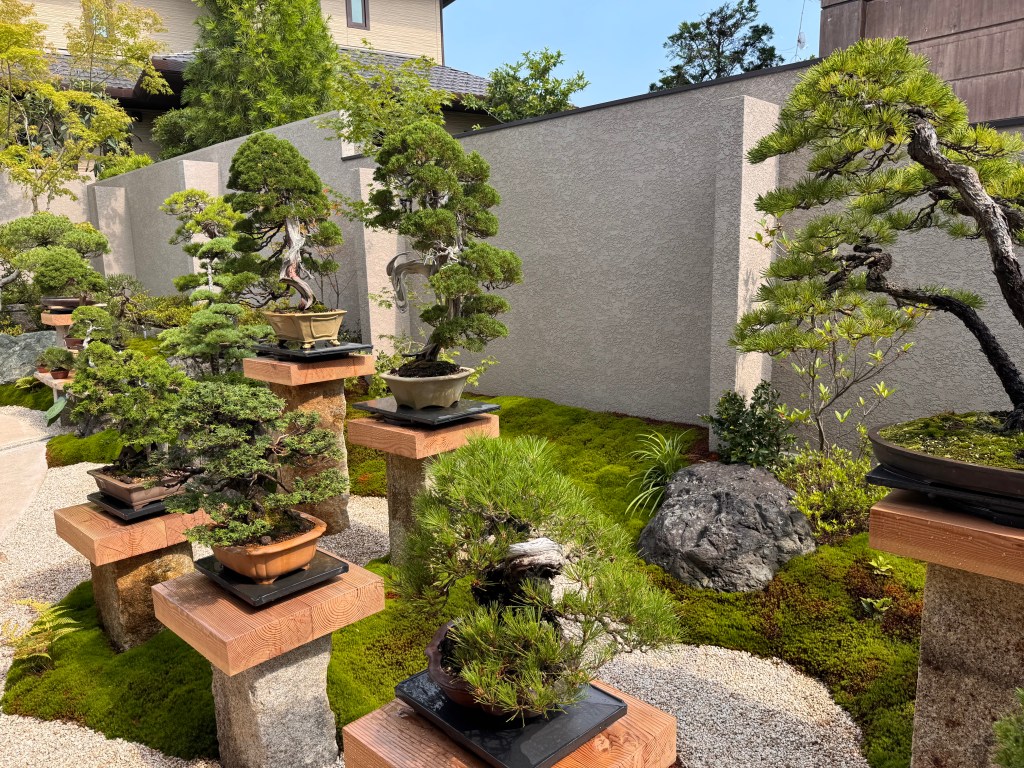
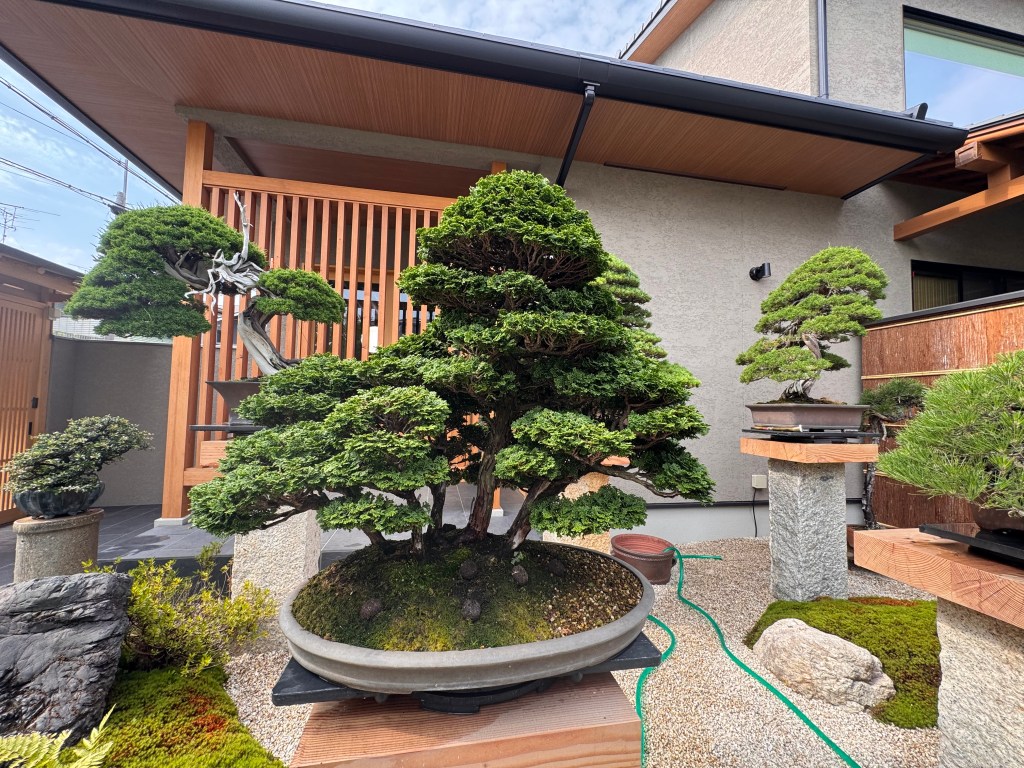
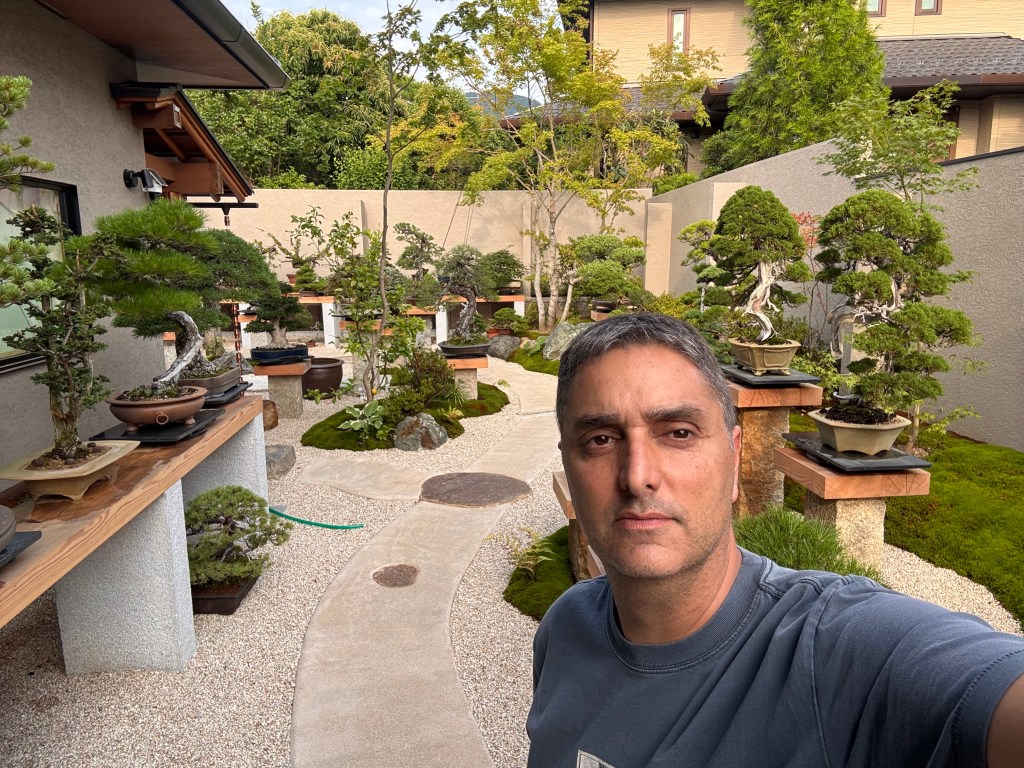
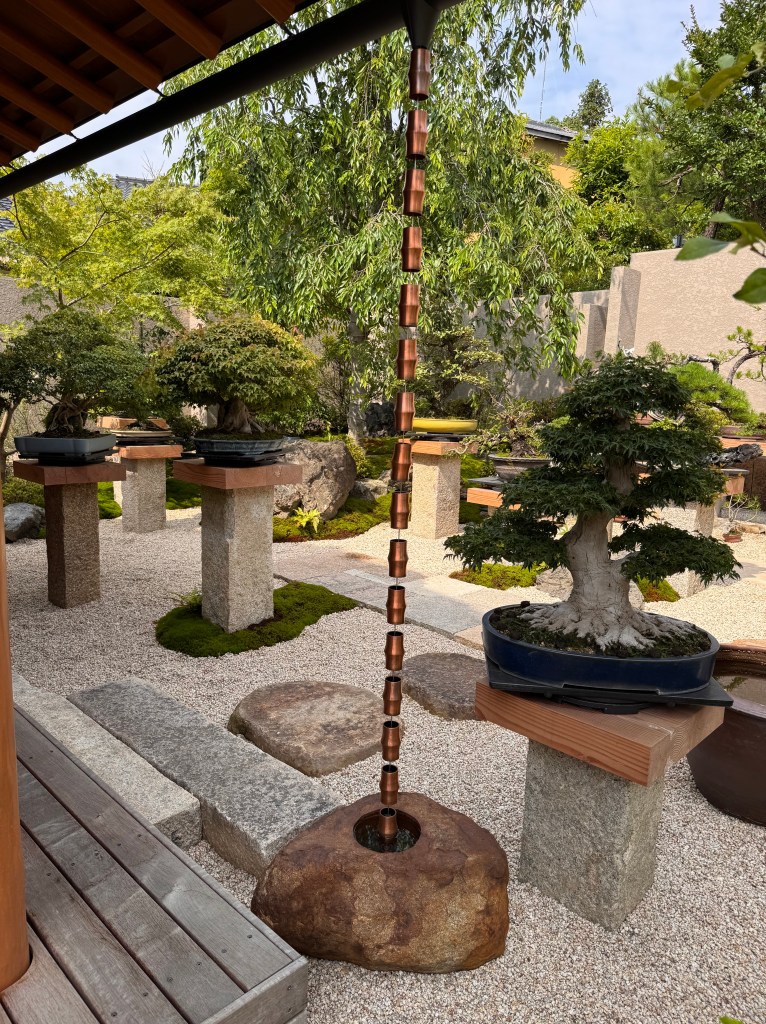
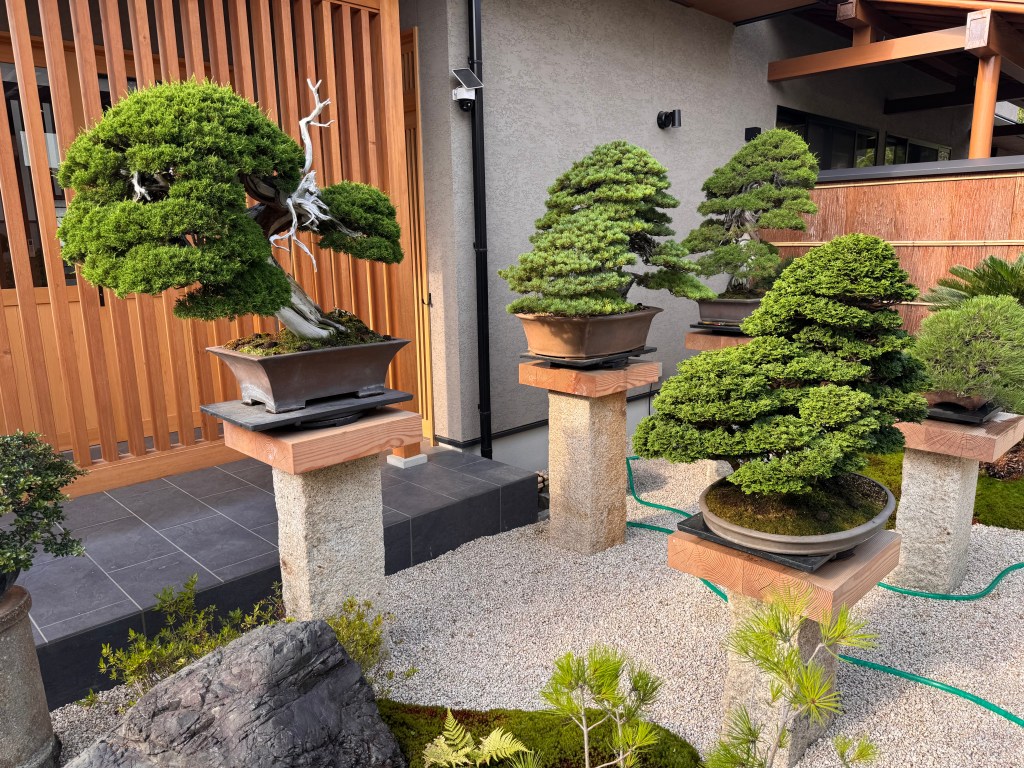
    Walking into his garden in person, after watching so many videos of it, was something else. Every detail felt considered — the landscape, the stands, the rocks, the trees, even the gutters were quietly beautiful. It’s the kind of space that represents where so many of us hope to get to one day: bonsai as art and science, with an aesthetic sensibility running through everything.
    The gutter!!

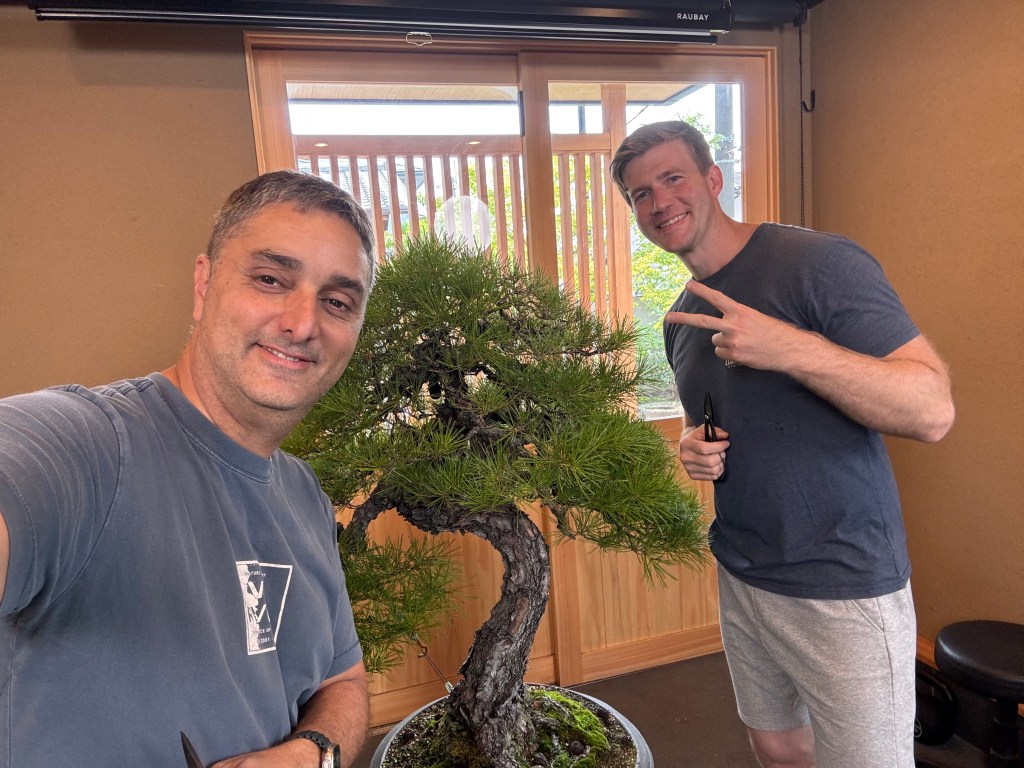
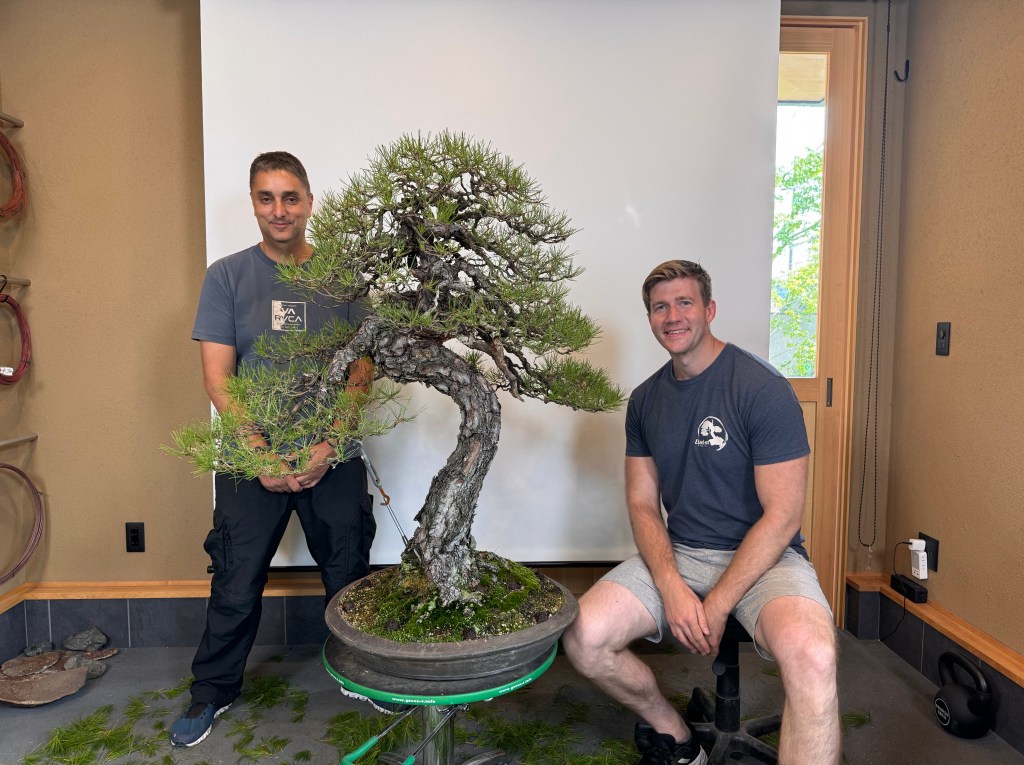
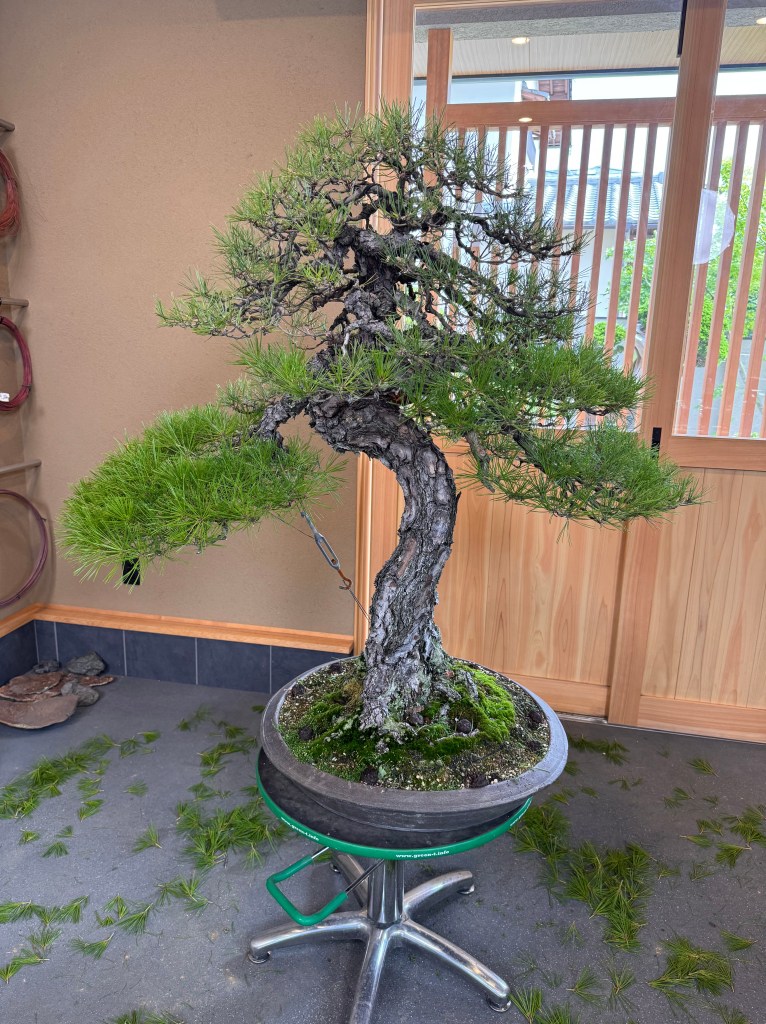
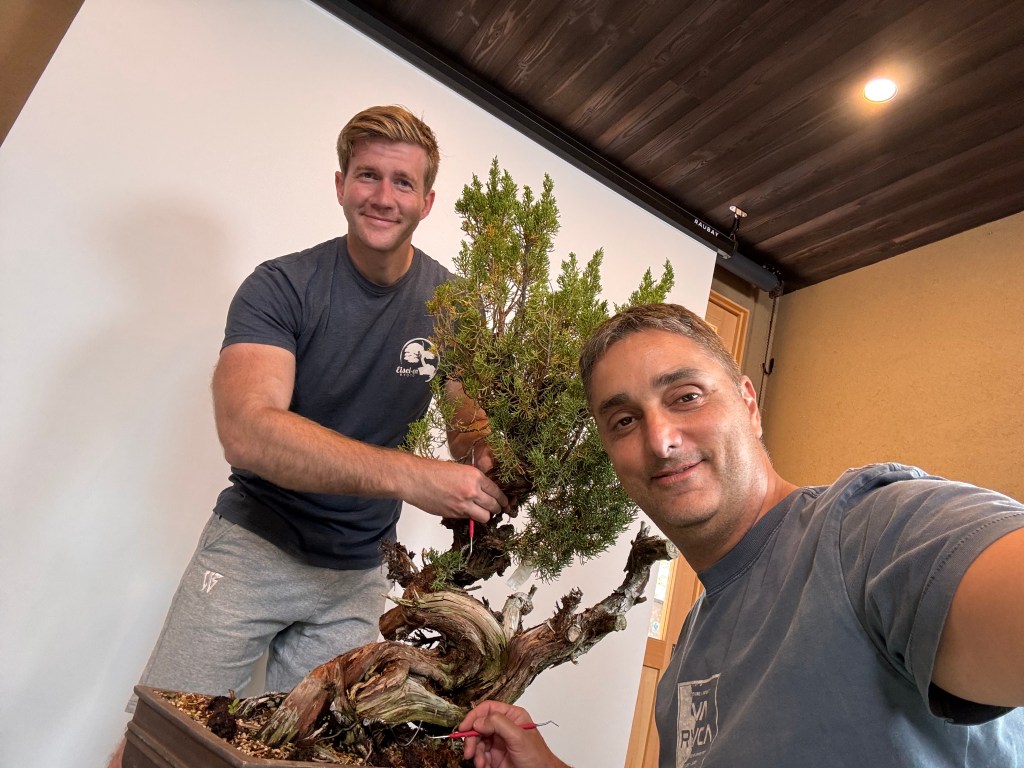
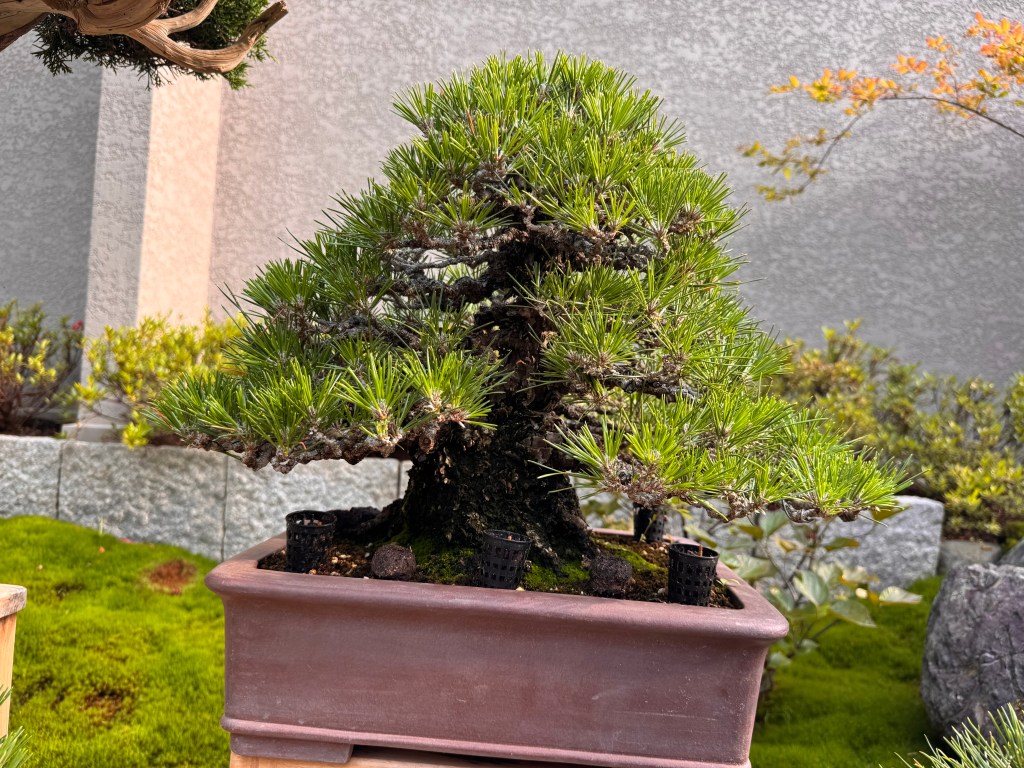
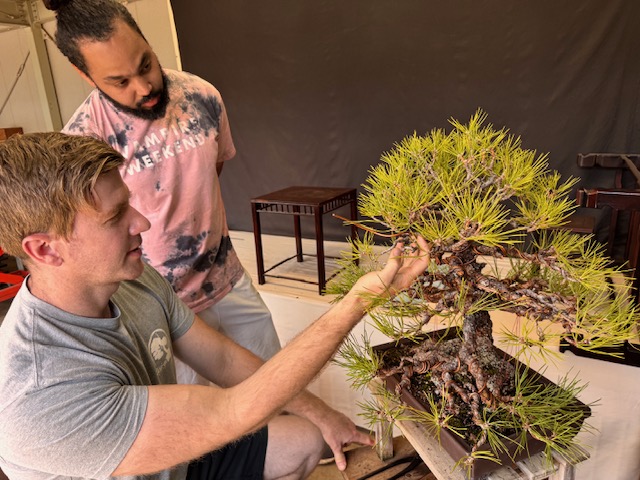
    After taking it all in, it was time to get to work. Bjorn offered a few options, and since it’s pine candle season, we went for it — starting with mekiri (candle cutting) on a striking red pine that had once been part of the famous Kokufu exhibition in 1977.

    The final result

    Bjorn walked me through it patiently, and we spent a couple of hours working through the tree, learning to tell strong, medium, and weak candles apart. Along the way we talked — about my path into bonsai, the growing scene in Israel, his own journey. It felt less like a lesson and more like a conversation between friends.

    From there we moved to a second tree — a raw, likely yamadori material from a forest collection — and started talking through styling options, beginning some early deadwood work.

    before departing his house – had to have the last round again – to absorb it all….

    One day this tree will be mine!

    On the second day, Bjorn took me to Fujikawa Kokonoen, the nursery in Osaka where he’d apprenticed years before. It’s one of the legendary names in Japanese bonsai — Mr. Fujikawa is a master known for decades of refining some of the finest pine and deciduous material in the country, and the nursery itself is essentially a living museum of trees that have passed through generations of careful work.

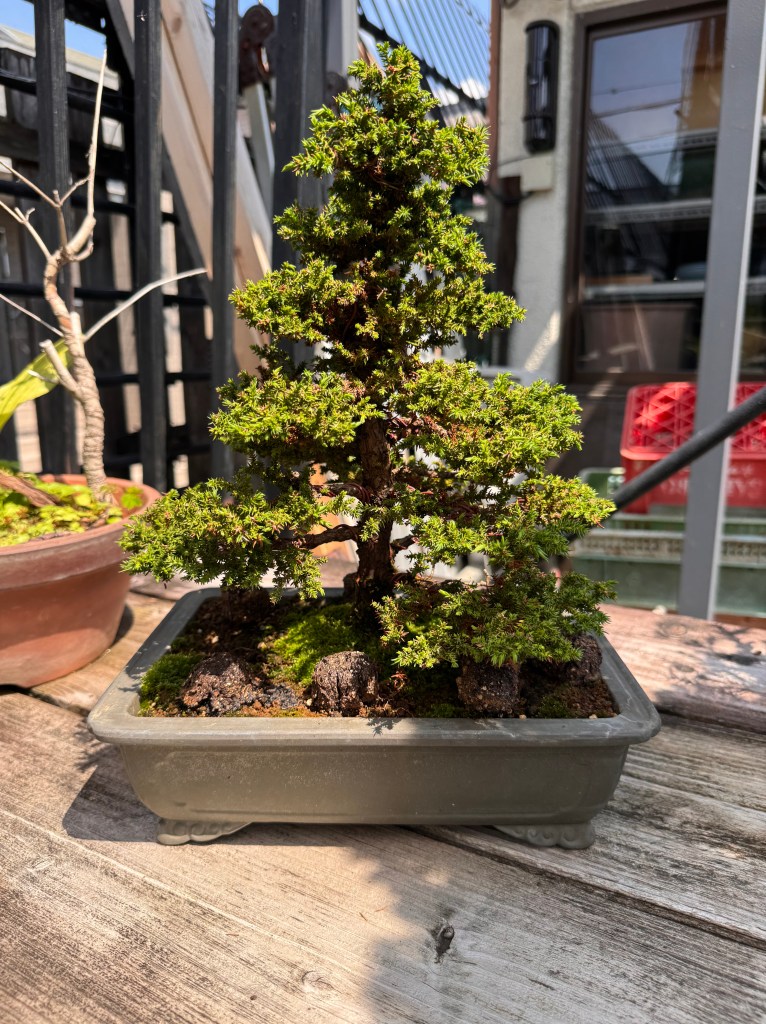
    Japanese Cedar – early stages but already perfect

    As we walked in, we met Joe, an American apprentice just four weeks into the program. We joked that he was still in the “everything is amazing” smiling phase — and honestly, watching him watch Bjorn, you could see the admiration plainly. Joe’s Japanese is still basic, so having Bjorn there to translate with the oyakata was a huge help.

    Joe was working on a black pine, and Mr. Fujikawa asked Bjorn to give him some pointers. There was something special about watching that — the expert guiding the newcomer, translating not just language but technique. When Mr. Fujikawa came over afterward to review the work, he seemed pleased, and through Bjorn he told Joe: it’s fine for where he’s at, but work slowly, don’t rush, be patient — if you work slow and smart, you actually get to a better result faster. Three generations of bonsai knowledge, right there in one exchange.

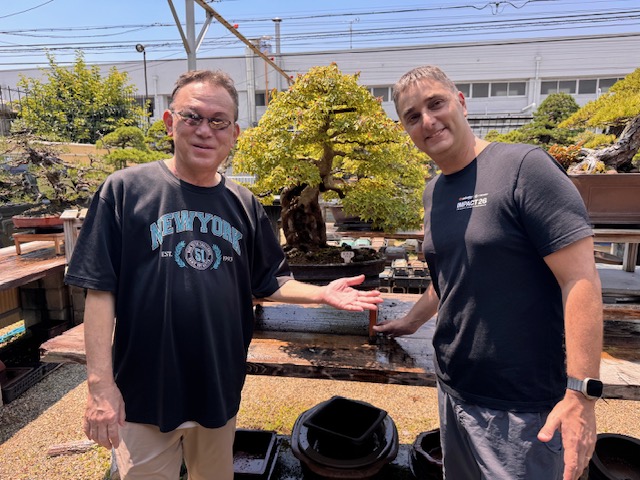
    When Bjorn introduced me to Mr. Fujikawa, I went through the same ritual that’s become a thread of this trip — I gave him the last of my pomegranate bowls, which he clearly loved. He invited me to sit with him for tea, a welcome break from the heat, and afterward we walked through his garden together and took some photos. Before we left, he gave me a gift: a heavy suiseki stone. Lucky for me, my suitcase still had room…

    On the drive back to Kyoto, we talked a lot — about the different masters and their approaches, but also about something more sobering: the sense that the level of bonsai material in Japan is quietly declining, as Chinese buyers acquire so many trees that they rarely get the chance to reach true perfection before being sold.

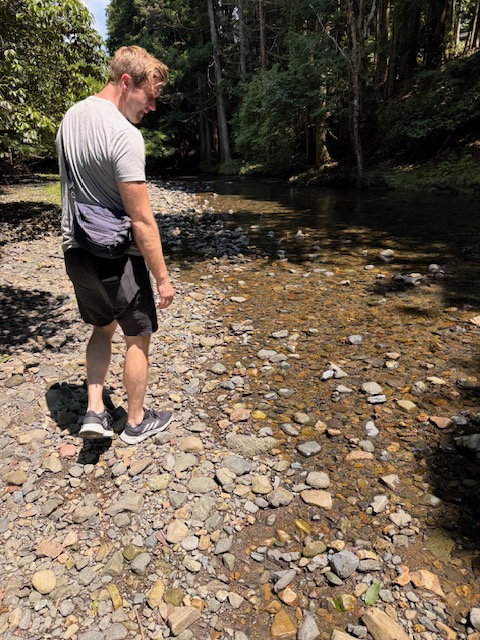
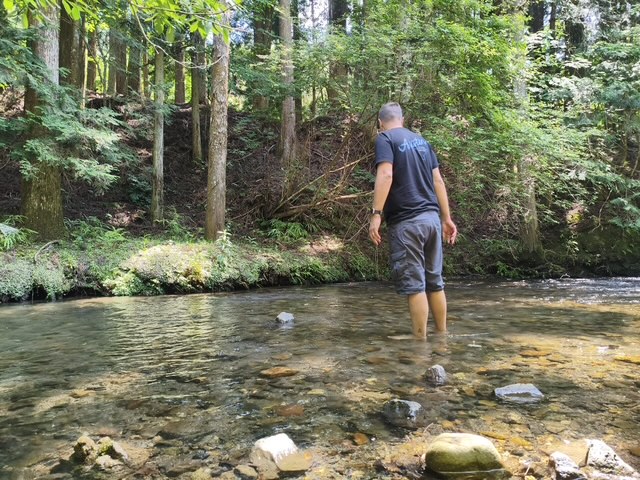
    To round off the adventure, Bjorn suggested something completely different — not trees this time, but stones. He’s a Suiseki enthusiast himself, and on the way back to Kyoto we stopped at the confluence of the Kurama and Kamogawa rivers, famous for the unique stones found there — searching the riverbed for shapes that echo mountains and landscapes in miniature.

    It was a strangely meditative experience. A couple of months ago I never would have guessed I’d be wading through a river in Japan hunting for stones — my wife Anna has always been the one drawn to suiseki, something I’ll admit I never quite got. Now, somehow, I get it.

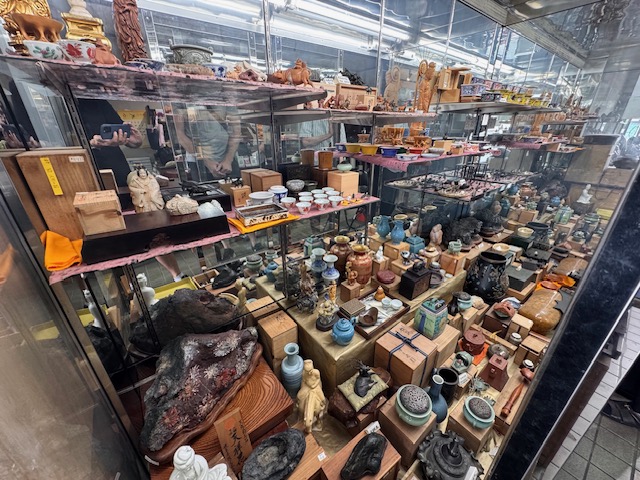
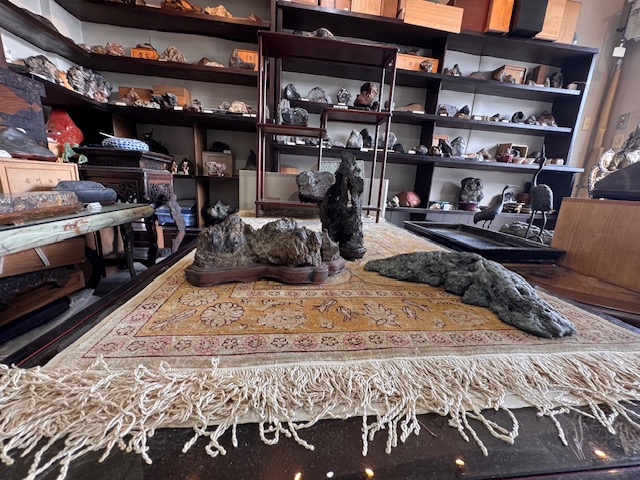
    After a while searching, we visited Kawai Kosoen, a collector’s shop unlike anything I’d seen — stones paired with daiza stands carved to fit their exact contours, antique suibans for miniature zen gardens, decades of quiet artistry in every corner. A calm, grounding way to close out the day.

    That afternoon with Bjorn — trees, garden, stones, zen — captured something I’ll carry with me for a long time.

    And with that, the bonsai pilgrimage comes to an end. As I start the long journey home — suitcase heavier with pots and a stone I definitely didn’t plan for — I’m reminded that the real weight I’m carrying isn’t in the luggage. It’s in everything I saw, learned, and felt: gardens built with intention down to the last gutter, masters guiding apprentices with patience across generations, old friends made new, and a craft that connects art, nature, and time in a way that’s hard to put into words.

    This trip didn’t feel like an ending. If anything, it felt like a beginning — a deeper appreciation for the path, and a renewed hunger to keep walking it.
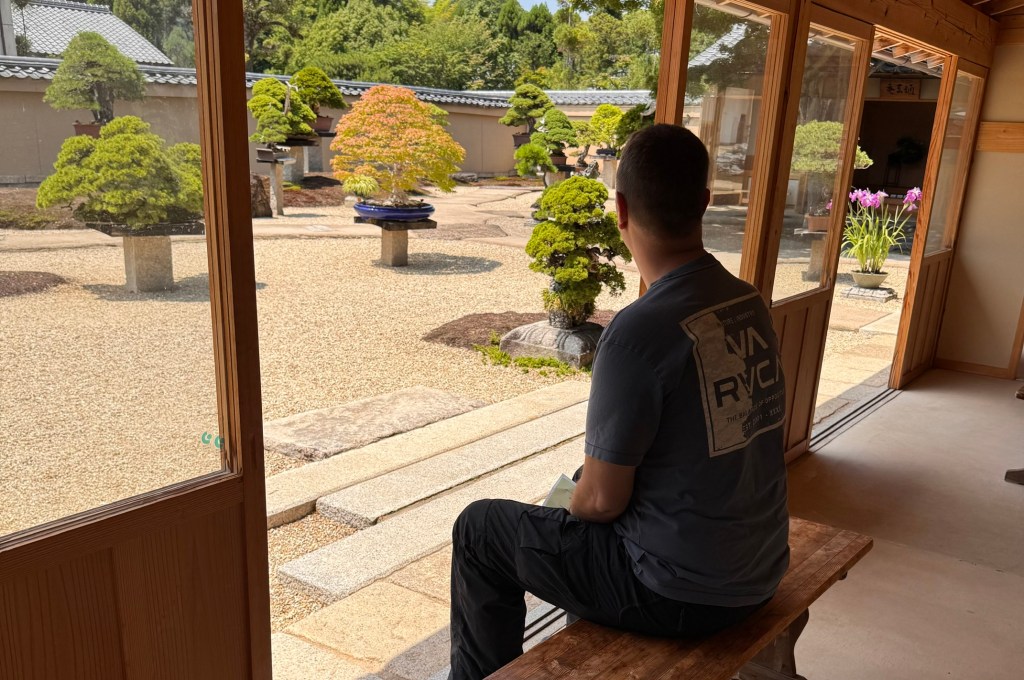
    Until the next journey, Sanoyara Japan – and thank you for eveything you gave me!

    BonsaiNomad

  • Daitoku-ji’s Hōshun-in – A Garden Just For Me

    Daitoku-ji’s Hōshun-in – A Garden Just For Me

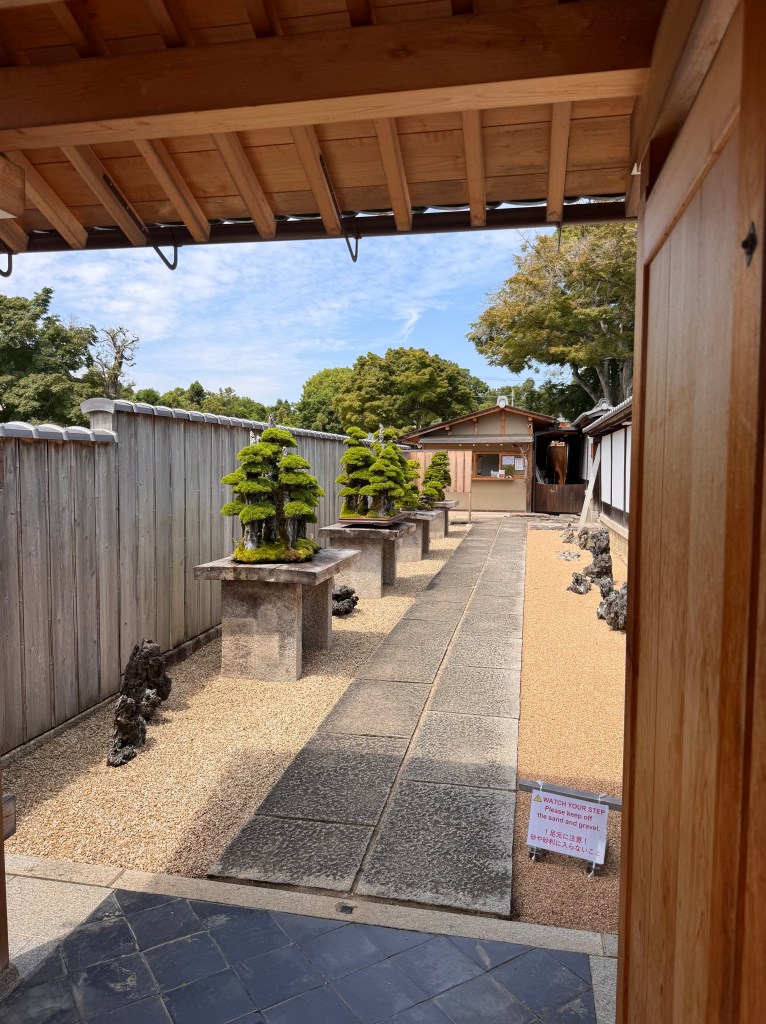
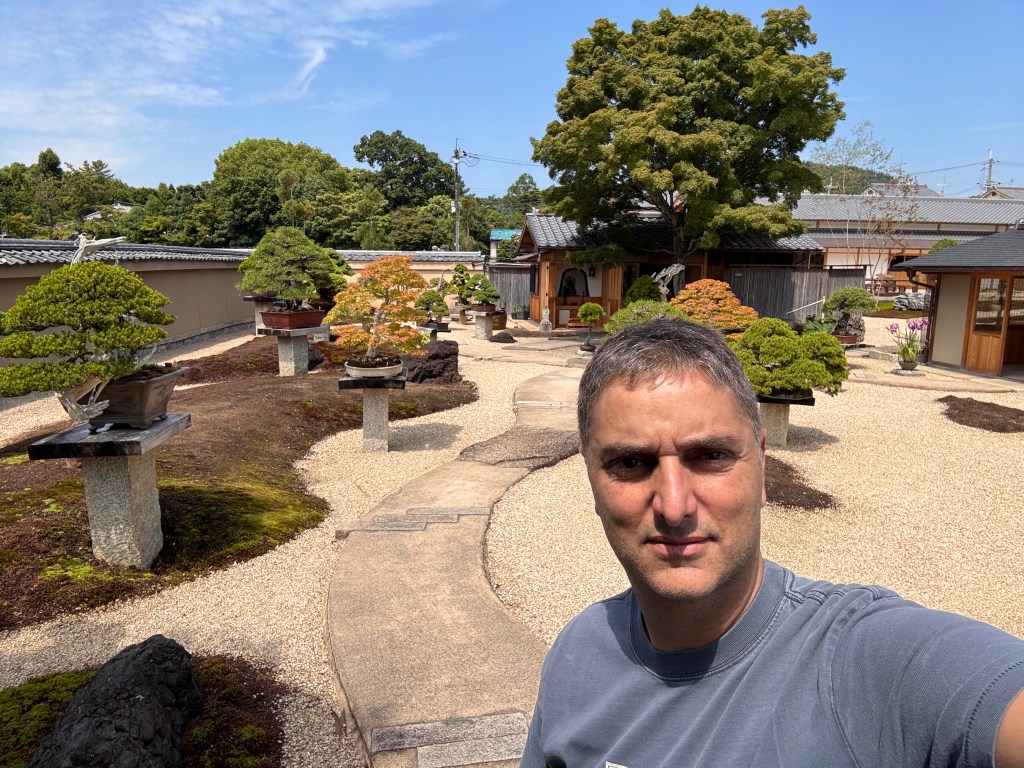
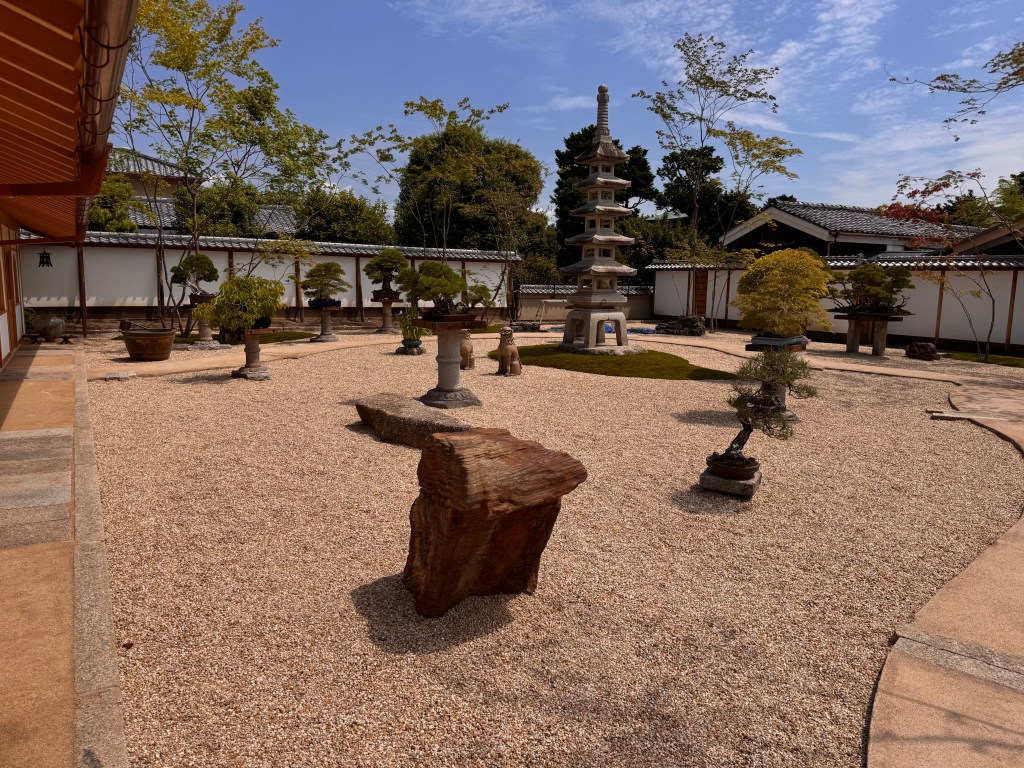
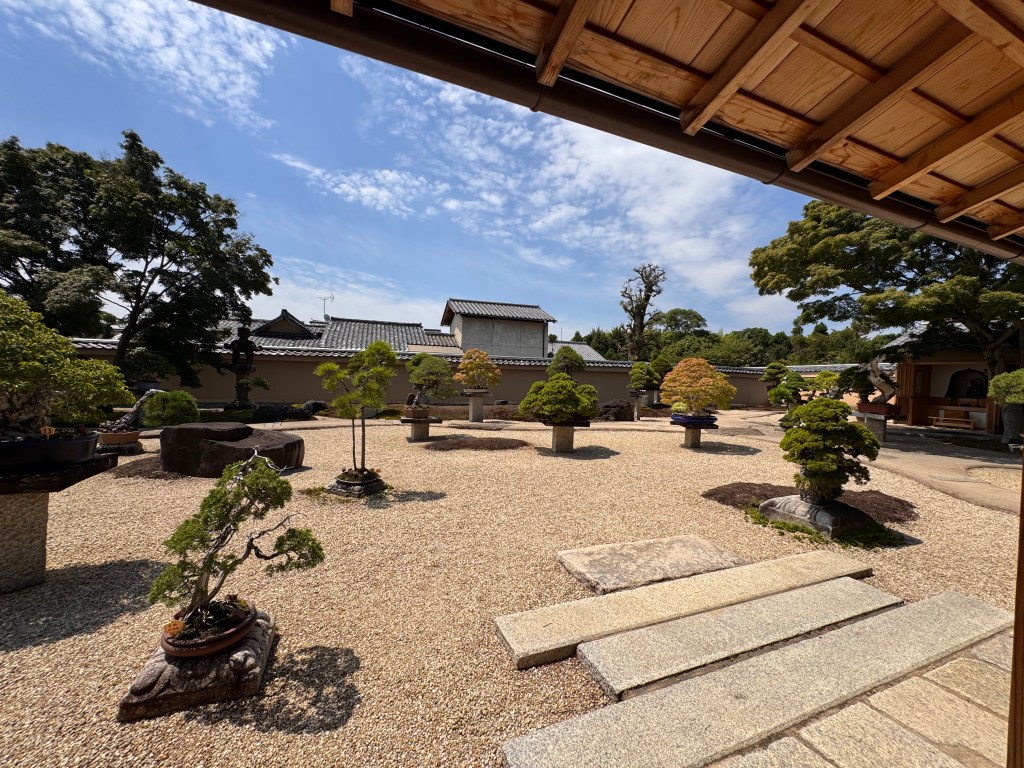
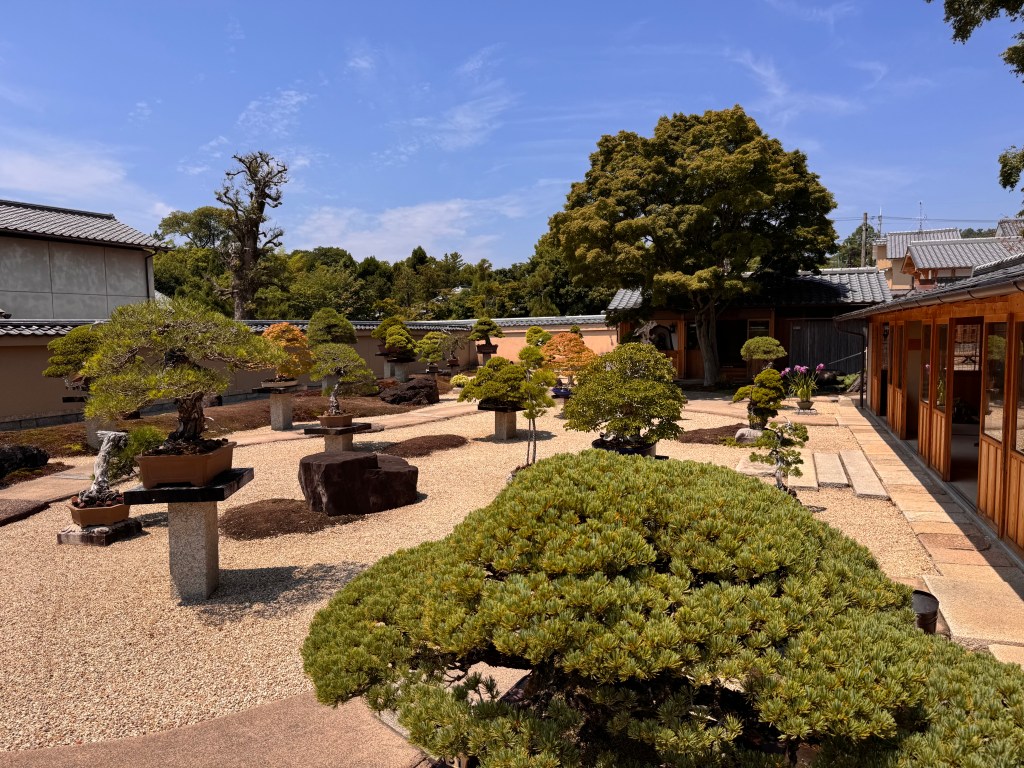
    I started my morning at Daitoku-ji, a vast Zen temple complex in northern Kyoto, founded in the 14th century. Among its many temples and gardens, I made my way to Hōshun-in — a famous bonsai garden I had known only from books and countless bonsai videos. I arrived just as the gates opened, and for the entire visit, the garden was mine alone — just me and the trees.

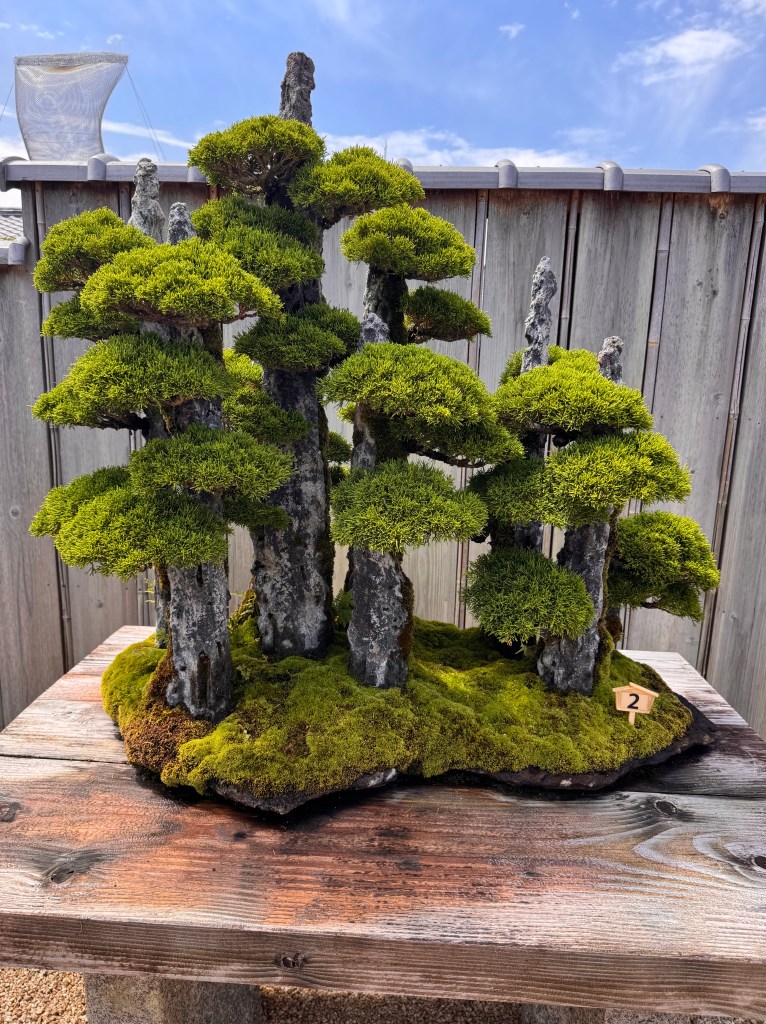
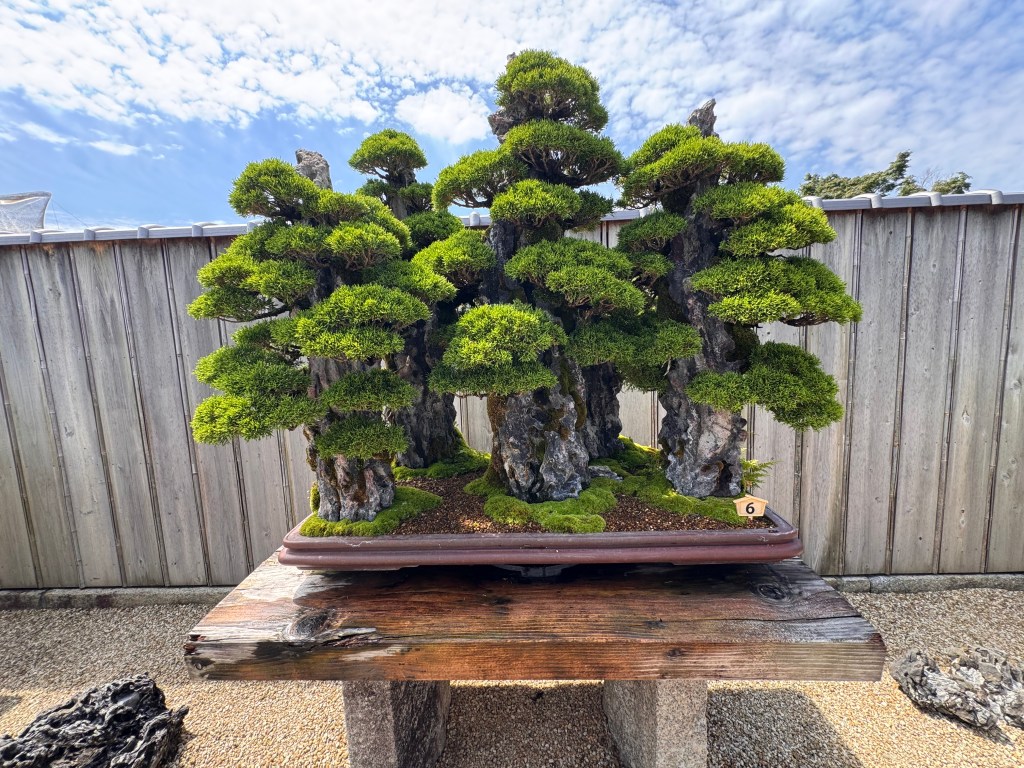
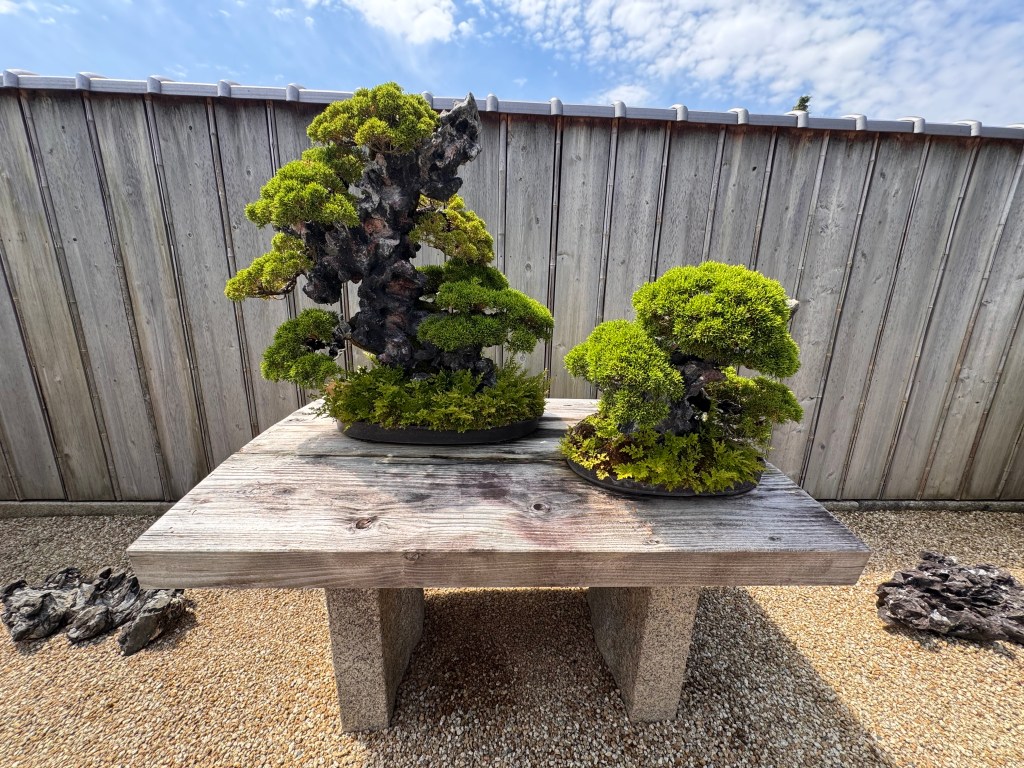
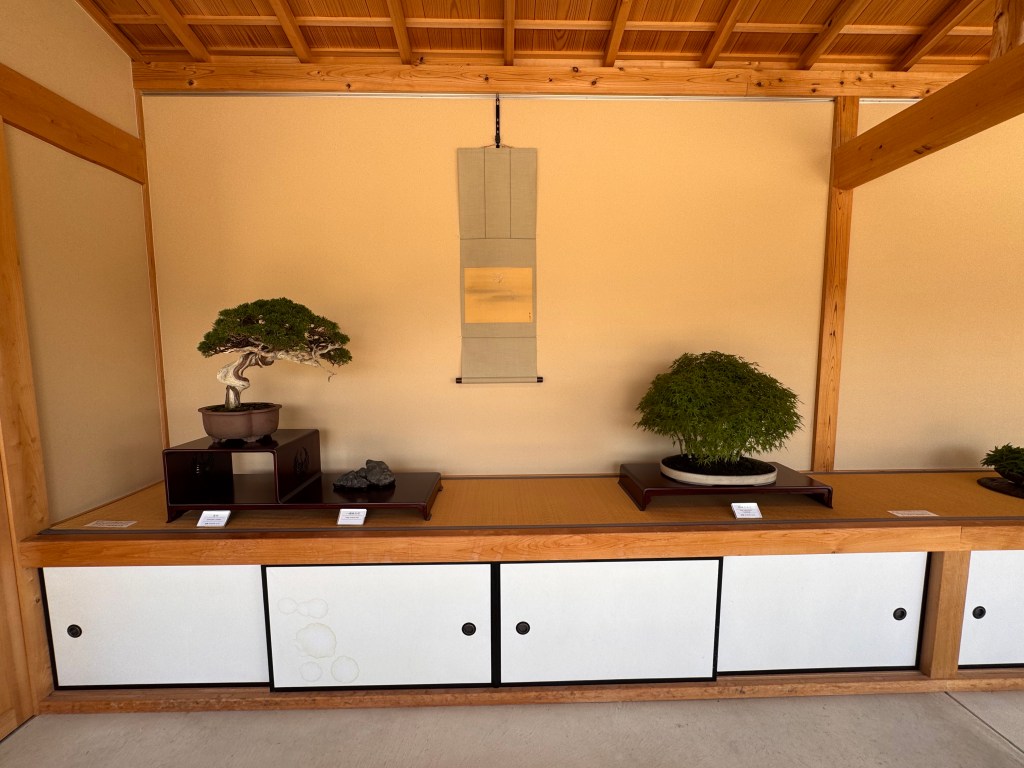
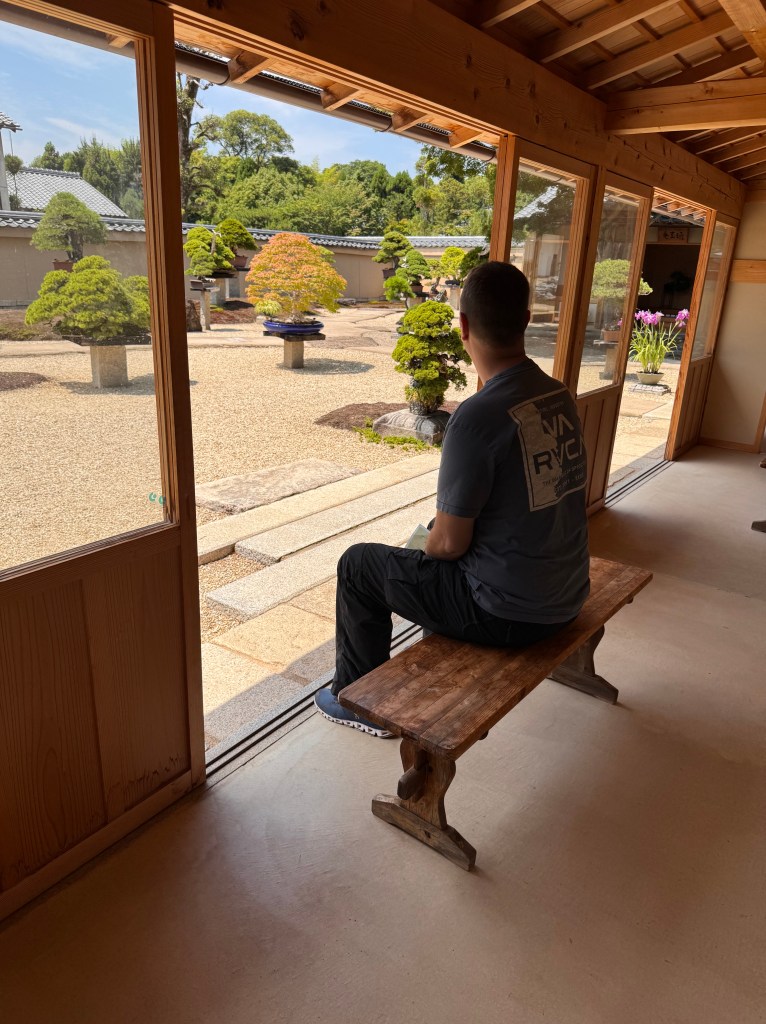
    I walked the marked trail and went tree by tree, taking my time with each one. The collection is really impressive — pines, junipers, maples, all displayed outdoors on individual stands, numbered and labeled. If I could have a display like this in my own backyard one day, that would be a dream.

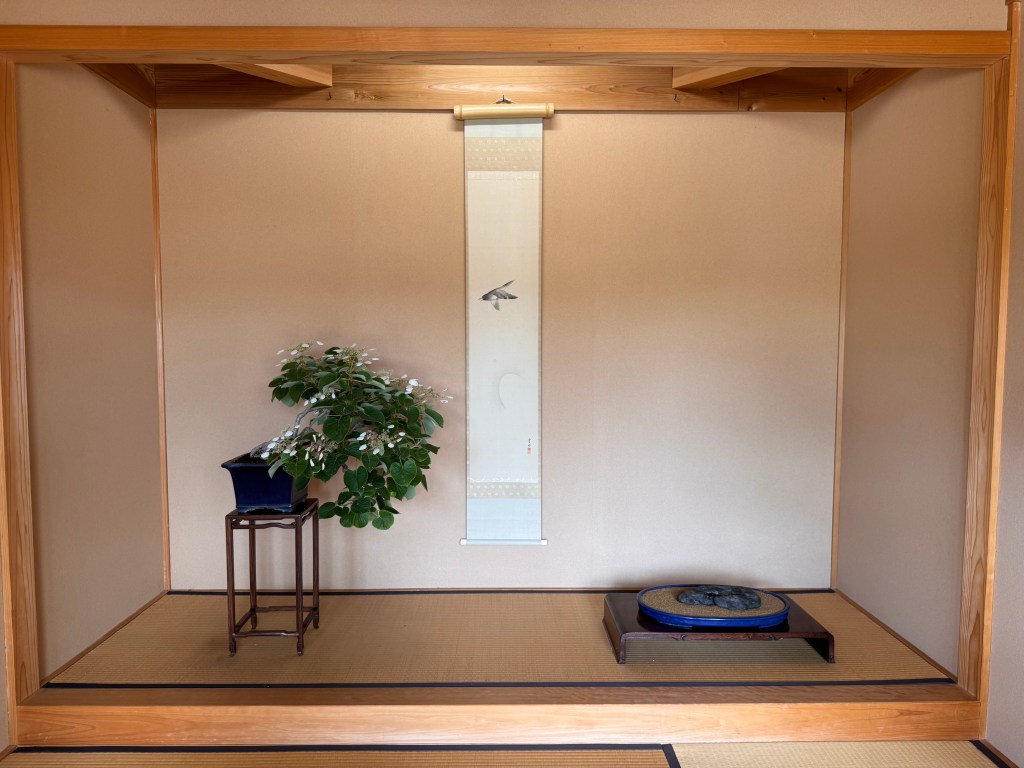
    Indoors, the display alcoves – “Tokonoma” – showed me something I hadn’t fully appreciated before — the complete picture. A tree, a hanging scroll, a viewing stone, sometimes a second accent tree, all arranged together to tell one seasonal story. In one alcove, a flowering hydrangea sat beside a scroll of a swallow in flight, with a small stone on a tray beside them — sea, sky, and shore, distilled into three objects on tatami. In another, a juniper and a maple flanked a scroll, with a black stone shaped like a distant mountain resting on its own little stand.

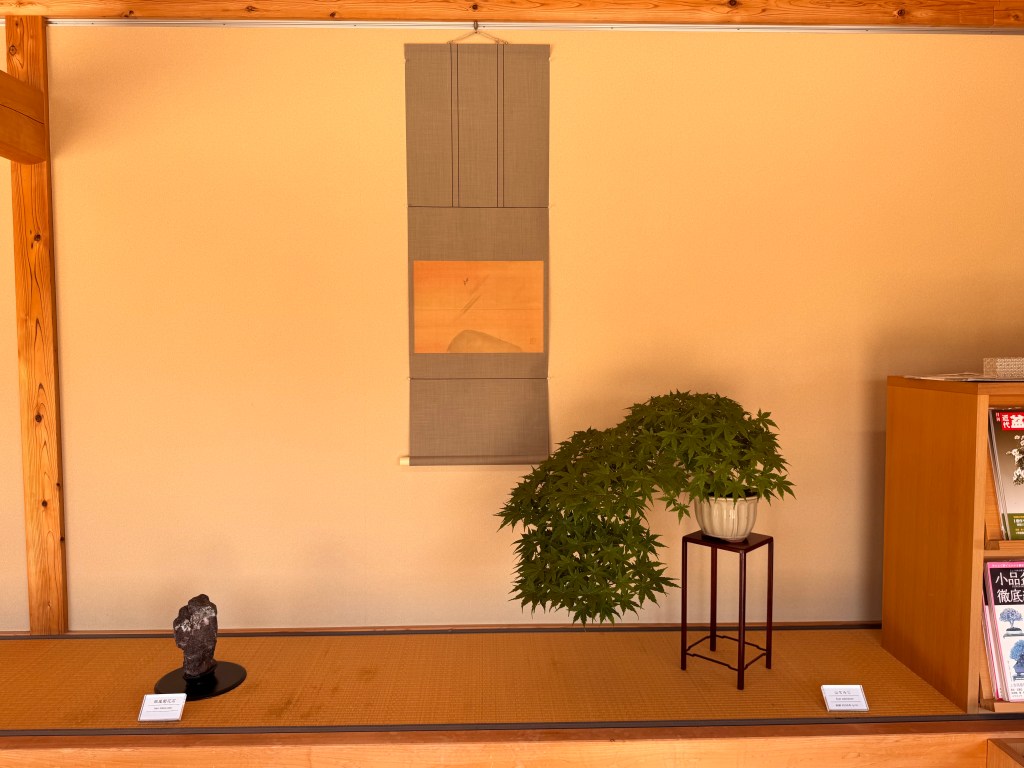
    Then there was a rock displayed completely on its own, no plant at all — labeled Yase Sudachi-ishi, a stone from the Yase area, presented with the same reverence as any tree. That’s when something shifted for me.

    I sat on a bench for what must have been thirty minutes, just looking. Thinking about how six months ago I knew nothing about any of this, and now here I was, alone in a centuries-old temple garden, completely absorbed. What had brought me to this new passion? What does it actually mean to spend this much time and care on something so small, so slow? It led me somewhere bigger — toward what’s really important in life.
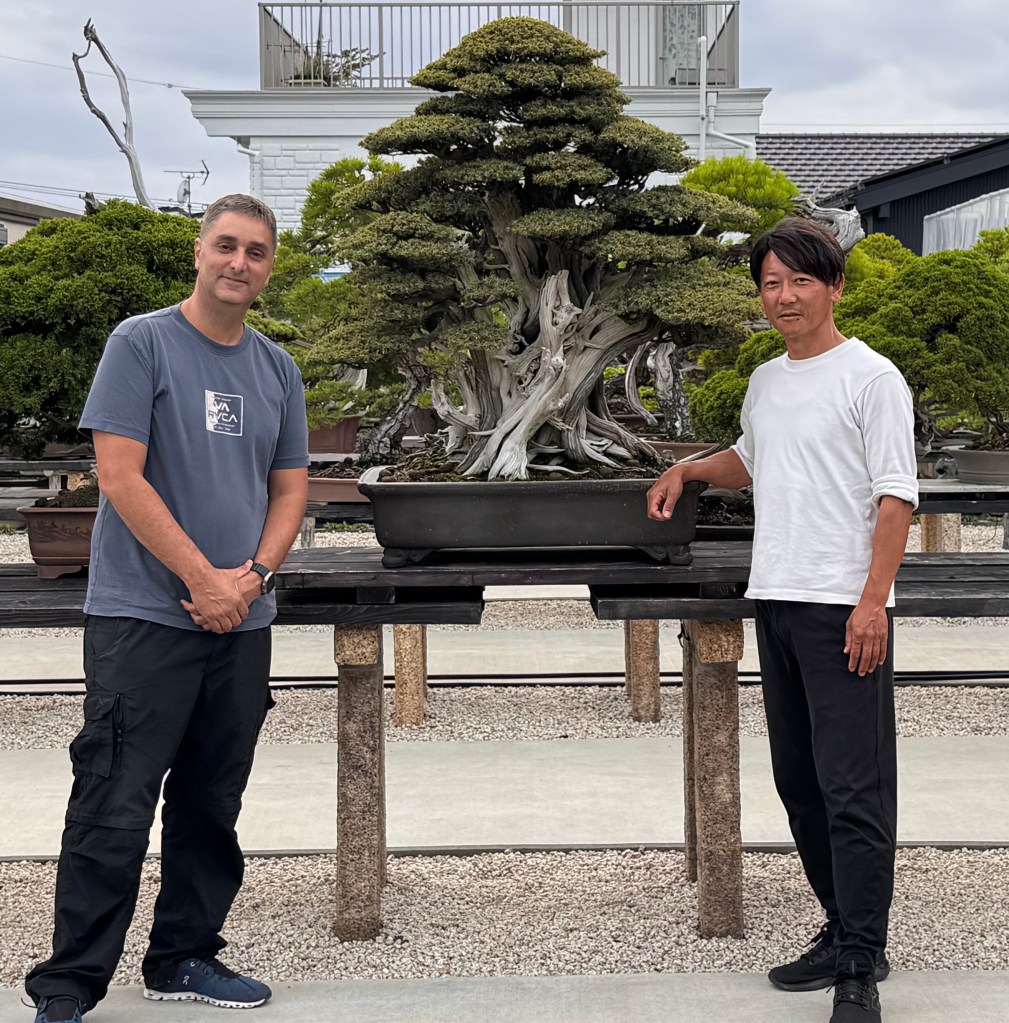
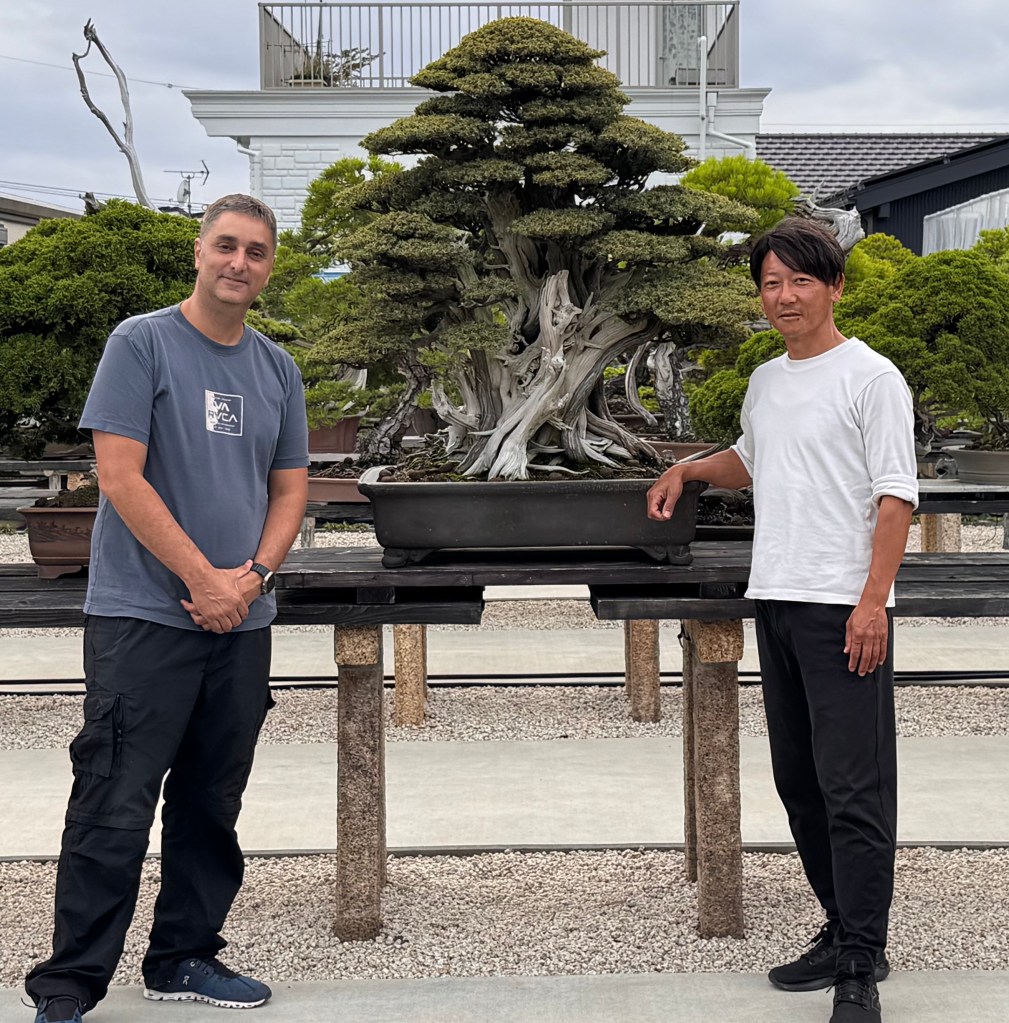
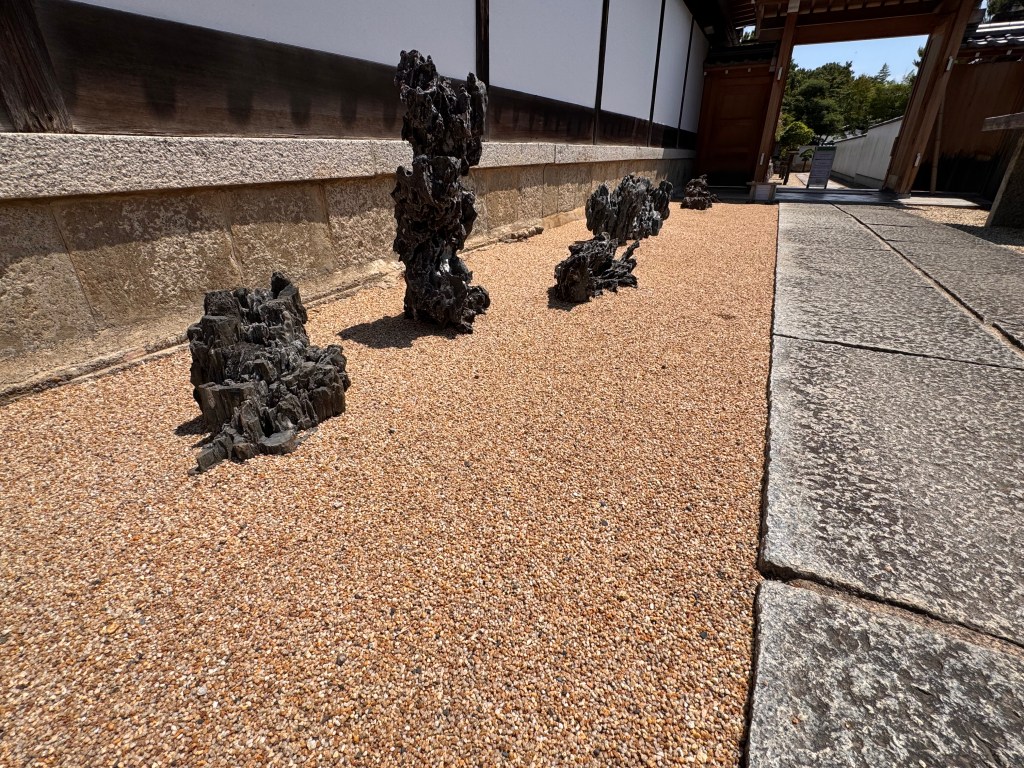
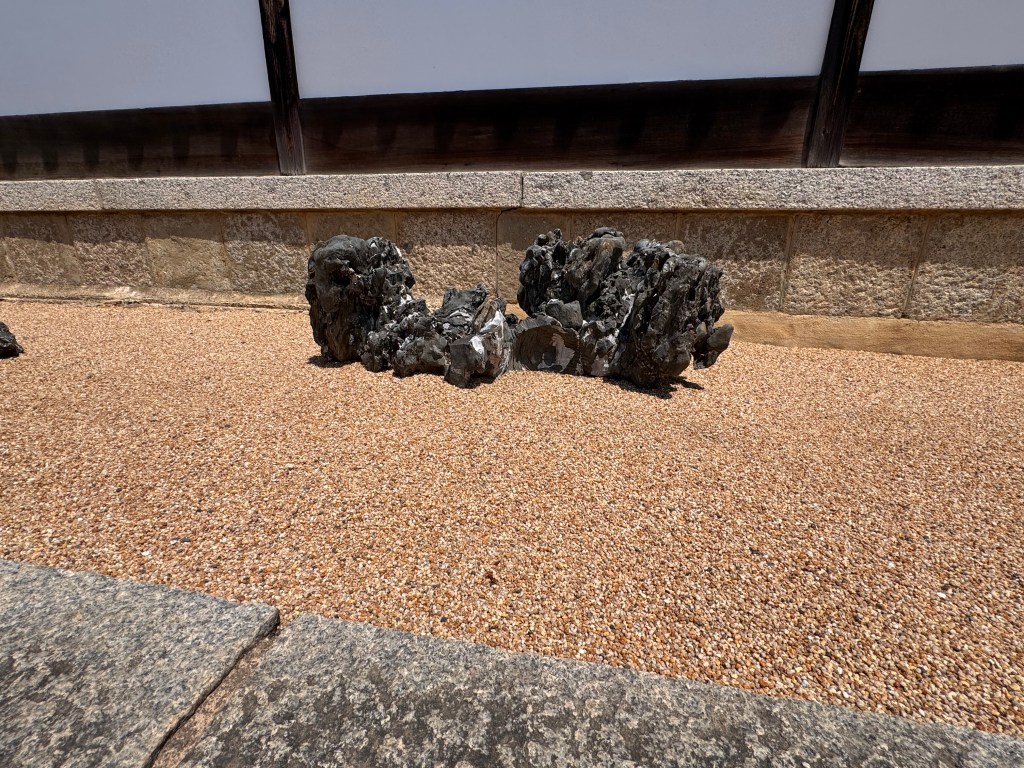
    When I got up and looked again, I noticed the details I’d usually walk past: the overall garden setting, the moss, and — the rocks. Wow. These rocks. All of a sudden it hit me. This wasn’t just a nice garden with nice stands holding nice trees. It was the entire landscape — the sea, the mountains, the forests — compressed and suggested through stone and moss and form. The individual bonsai stopped being individual specimens and became elements in something much larger, the way a single stone in a Zen garden stands in for an entire mountain range.

    As I walked away, I noticed more stones along the trail leading toward the garden — mountains, on the way in, that I hadn’t seen as mountains the first time. Only the trees, on the way in. The complete picture, on the way out.

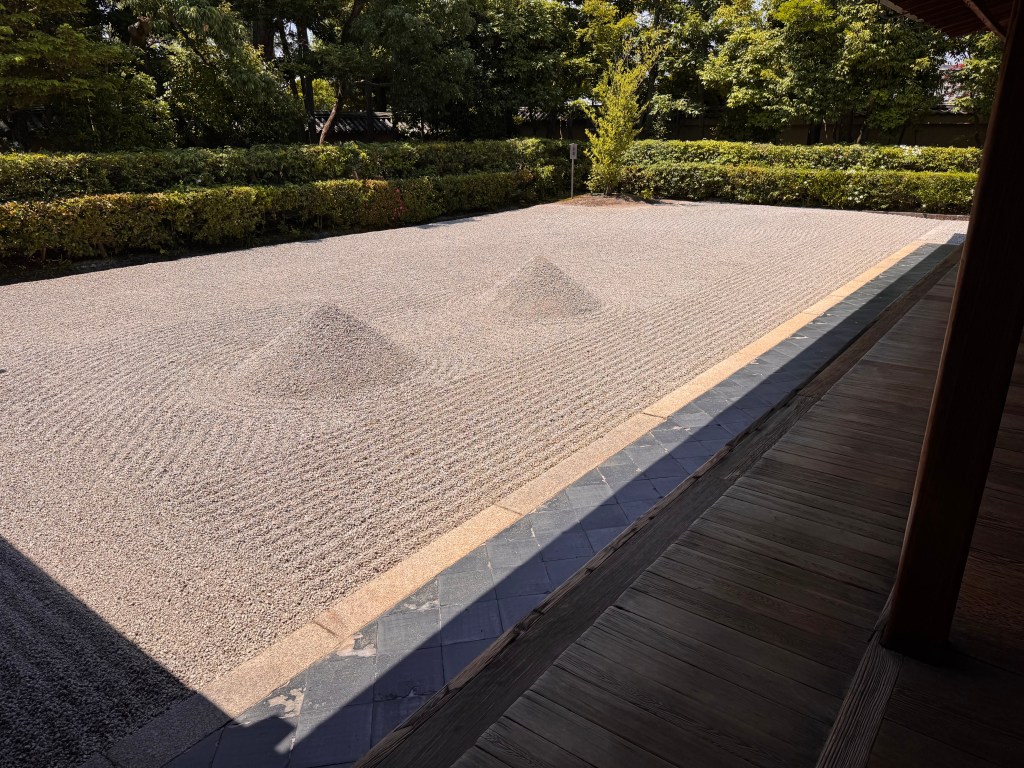
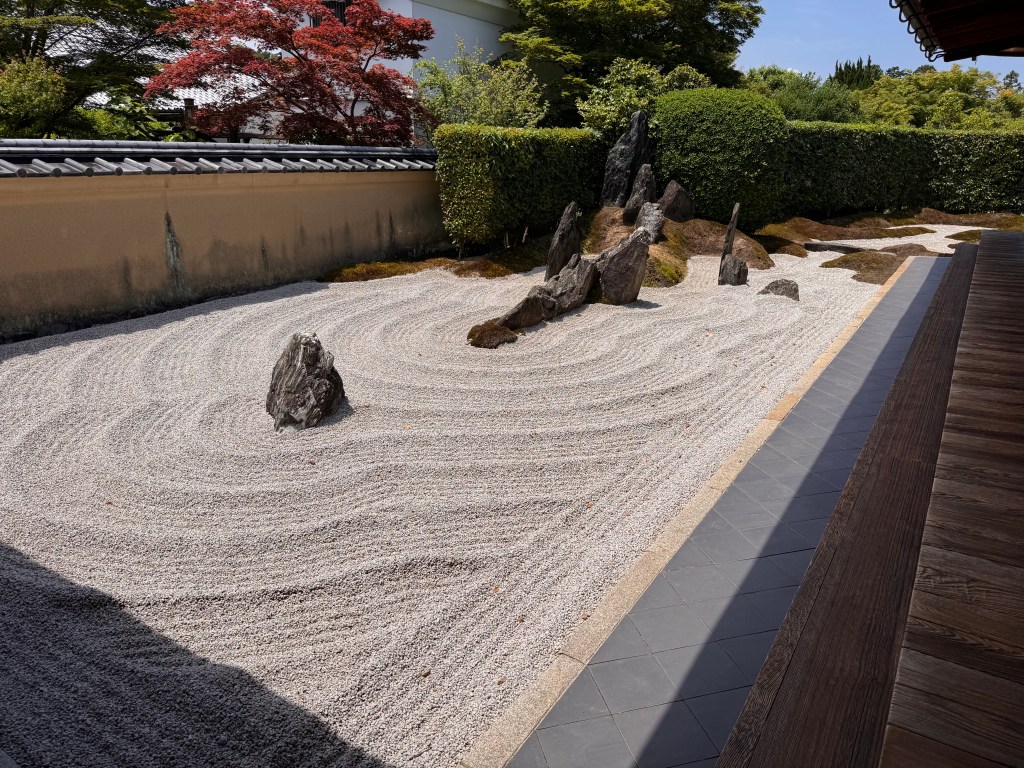
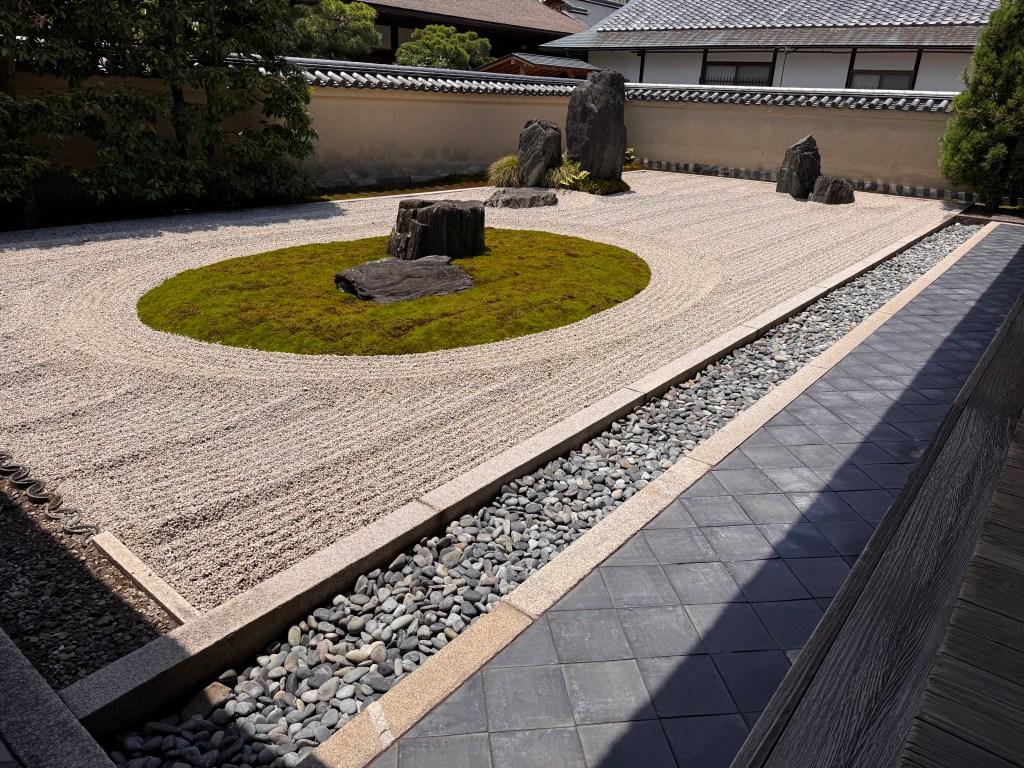
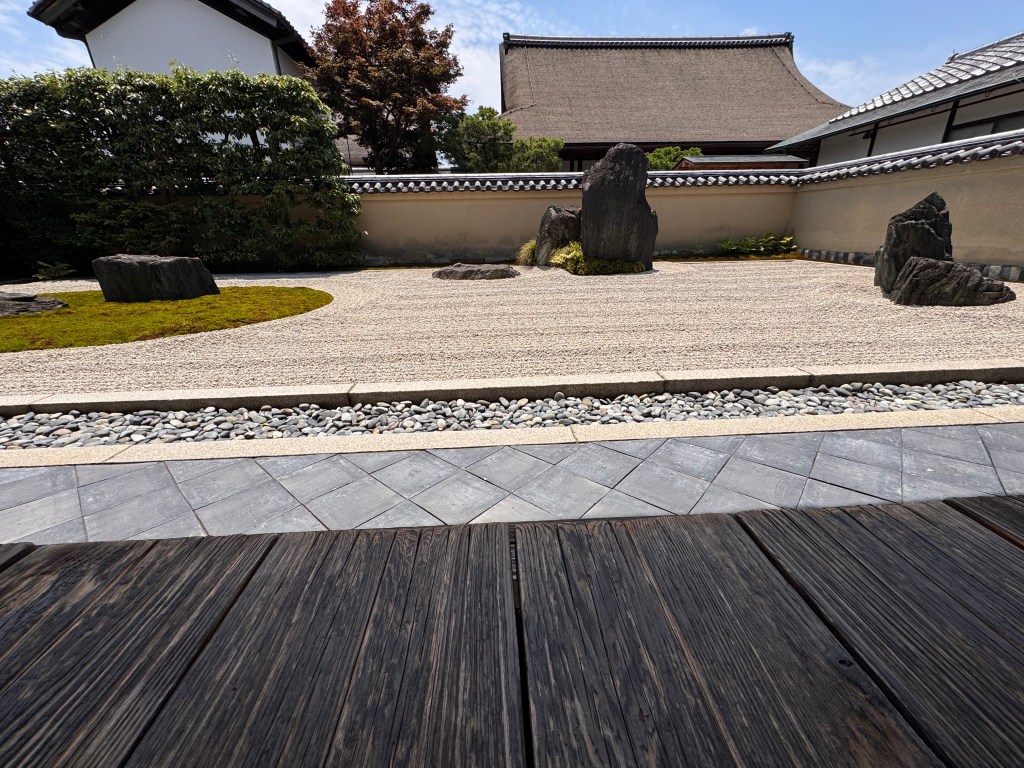
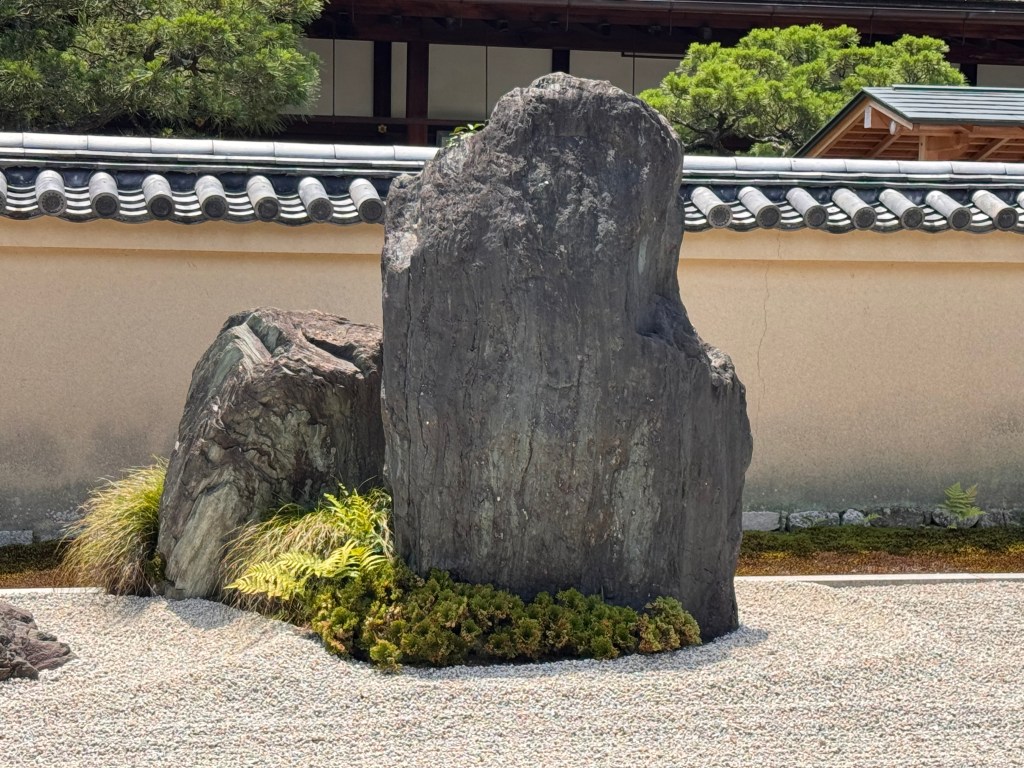
    From Hōshun-in I continued into the wider Daitoku-ji complex — a sprawling maze of walled sub-temple compounds connected by stone paths, red-lacquered gates, and centuries-old pines leaning over tiled walls. Daitoku-ji is the headquarters of the Rinzai Zen school founded in the 14th century, and many of its sub-temples hold their own karesansui, dry landscape gardens — where the principle I’d just stumbled onto at Hōshun-in is taken to its purest form.

    A Zen garden uses rock, raked gravel, and moss instead of water and living plants to create a distilled, abstract landscape meant for contemplation rather than walking through. Raked gravel represents water — rivers, oceans, ripples around obstacles. Large vertical rocks represent mountains, islands, or sometimes a Buddhist triad. Moss suggests forest and the passage of time. And the empty space between elements is as important as the elements themselves — it’s where the mind completes the scene.

    Walking these gardens after my morning at Hōshun-in, I couldn’t unsee it. Every rock was a mountain. Every raked line was water. The whole complex was one continuous meditation on landscape, scaled from a single bonsai pot to an entire temple ground.

    I left Daitoku-ji slower than I arrived — which is really the whole point, I think. From here – to another part of Kyoto – Visiting Bjorn! something I’ve been looking forward to for a long time. More on that soon.

    .